
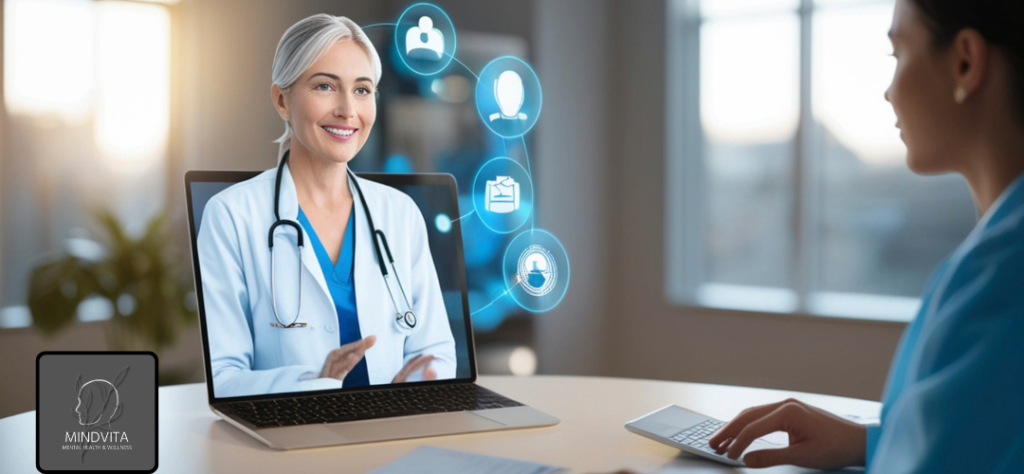
Access to medical care in time is a lifesaver. In the current healthcare setting, telehealth urgent care is revolutionizing the way patients can access urgent medical care. Telehealth urgent care is an immediate, convenient and safe alternative to visiting the emergency room. Online doctor visits, such as those offered by Mindvita are leading the revolution in telehealth urgent care and offering patients access to licensed professionals no matter where they are in the world.
Online doctor visits, made possible by technology, AI, and telehealth platforms, are revolutionizing emergency medical access and offering better patient outcomes and relief to the healthcare system. In this article, we will discuss the telehealth urgent care phenomenon, its impact, innovations, challenges and the future of online doctor visits.
The Telehealth Urgent Care Phenomenon
Telehealth urgent care has evolved from the days of phone consultations to what it is today, a high quality urgent care service for acute conditions such as infections, allergic reactions, minor injuries and mental health emergencies.
The COVID-19 Pandemic: Telehealth urgent care became a necessity during the pandemic, ensuring that there were no unnecessary hospital visits and that patients could receive safe care in the comfort of their own homes.
AI Enhanced Triage: Predictive AI technology enables the prioritization of urgent patients and directs them to the appropriate destination.
Mobile Health Platforms: Patients can now schedule appointments, upload medical information and receive prescriptions via mobile health platforms.
For instance, a study conducted by AMA in 2022 proved that telehealth urgent care reduced non critical ER visits by 30%, thus proving the success of online doctor visits.
Technological Infrastructure
Telehealth urgent care is based on technology. Secure video conferencing, artificial intelligence triage and integration with Electronic Medical Records (EMR) ensure quality medical care during online doctor visits.
Technologies Used
Wearable Devices: Patients can be monitored continuously for vital signs such as heart rate, blood pressure and oxygen levels.
AI Symptom Analysis: The technology analyzes symptoms and predicts the severity and urgency of symptoms.
Remote Diagnostics: Online stethoscopes and glucose meters allow for remote diagnosis.
With these technologies, patients in rural areas or areas with limited medical facilities can now seek urgent care from the comfort of their homes, thus making online doctor visits a game changer in terms of accessibility.
Regulatory and Policy Support
The federal and state governments are formulating policies to support telehealth urgent care.
CMS Reimbursement: Most insurance companies now reimburse online doctor visits for urgent care consultations.
HIPAA Compliance: Secure online platforms such as Mindvita are used to ensure confidentiality and secure communication.
State Policies: Programs such as Virginia telepsychiatry increase access to mental health care through online consultations.
Expanding Access to Emergency Care
Before telehealth, patients in rural or hard to reach areas had to travel long distances to access urgent care. Online doctor visits have now broken geographic barriers.
Example: Patients in Virginia can now access mental health care through Virginia telepsychiatry services in addition to urgent physical care.
Telehealth technology increases accessibility for patients with mobility impairments, transportation issues or underdeveloped healthcare infrastructure in their area.
Solving the Problem of Overcrowding in Emergency Rooms
ER overcrowding is a widespread issue. Telemedicine doctor visits allow patients with minor emergencies such as mild infections or sprains to be treated from a distance, thus alleviating overcrowding in ERs for patients with serious emergencies.
Data: In 2023, a study found that hospitals implementing telehealth triage systems demonstrated a 25% decrease in non critical ER admissions.
Analogy: Telehealth technology is a filter that prevents only patients who require in-person treatment from visiting the hospital.
Faster Response Times
In the field of emergency care, time is of the essence. Telemedicine doctor visits allow immediate access to specialized doctors, which is faster than having to physically go to a clinic.
Example: AI assisted triage systems allow patients to enter their symptoms in minutes, referring emergency patients to the nearest ER and remotely managing non emergency patients.
Result: Patients receive immediate attention, thus ruling out the possibility of developing complications.
Improved Patient Outcomes
Telemedicine doctor visits allow for early treatment of patients with minor illnesses, thus preventing them from progressing into major illnesses.
Example: Telemedicine doctor visits allow for remote management of patients with minor infections, asthma attacks and allergic reactions, thus reducing the need for hospitalization.
Telehealth urgent care has been proven in studies to increase patient satisfaction and adherence to treatment plans.
Characteristics Fueling Telehealth Urgent Care
AI is used in modern telemedicine doctor consultations to predict the extent of urgency of a particular medical condition, thus allowing doctors to assign priorities to patients effectively.
Example: AI can detect symptoms of sepsis, heart problems or failure of respiration from patient submitted symptoms and wearable sensor inputs.
Multidisciplinary Telehealth Teams
Telehealth urgent care is a multidisciplinary team of doctors, nurses and specialists.
Example: The most effective telepsychiatry solutions provide mental health support along with urgent care, addressing stress or anxiety problems arising from physical ailments.
Benefit: Comprehensive evaluation enables holistic treatment, even in rural areas.
Remote Monitoring and Wearables
Telehealth wearables are used in online doctor consultations to monitor patients’ vital signs continuously and transmit real time information to healthcare professionals.
Example: Patients with diabetes, hypertension or heart disease can receive early interventions without having to step out.
Analogy: Telehealth wearables are a “digital nurse” that monitors patients continuously and notifies healthcare professionals.
Challenges and Limitations
Internet access and the presence of compatible devices are still a problem for some patients. Seniors also have problems with digital literacy.
Solution: Online platforms such as Mindvita have friendly interfaces, tutorials, and customer support available 24/7 to make online doctor consultations easy and convenient.
Clinical Challenges
Some emergencies, such as trauma, severe bleeding or heart attacks, cannot be treated online.
Solution: AI powered triage solutions can identify emergencies requiring immediate physical attention, ensuring patient safety.
Policy and Insurance Barriers
Insurance coverage for online doctor consultations is not uniform among states and insurance providers. It is important to mention insurance coverage for successful implementation.
Example: Telepsychiatry services in Virginia are connected to insurance companies to provide coverage for urgent mental health sessions.
Real World Applications Urban vs. Rural Implementation
Urban hospitals use online doctor consultations to reduce waiting times and optimize patient flow in ERs. Rural patients can also benefit from online urgent care without having to travel long distances.
Data: There was a 40% increase in the use of telehealth technology in rural areas between 2021 and 2023.
Pandemic Driven Growth
The COVID-19 pandemic has led to the increased adoption of telehealth technology. Patients resorted to online consultations with doctors for COVID-19 testing, common illnesses, and mental health assistance.
Example: Online platforms such as Mindvita saw a threefold increase in urgent care consultations during the pandemic.
Quantitative Outcomes
Unnecessary ER visits reduced by 25%
Patient satisfaction: 4.7/5 average rating
Cost savings: Reduced travel and hospital resource utilization
These statistics prove the vast potential of online doctor consultations.
The Future of Telehealth Urgent Care
The future of online doctor consultations will be inextricably linked with AI and IoT technology for predictive emergency care.
Example: Wearable technology for predicting asthma attacks, cardiac arrests, or respiratory failures before they become life threatening emergencies.

Policy Development
Governments are working on policy reforms to ensure the development of telehealth technology.
Trend: More states are adopting programs such as telepsychiatry near me, which integrates urgent mental health care with emergency care systems.
Scalability and Sustainability
Telehealth urgent care is an effective and efficient solution to the global healthcare industry, providing continuous access to healthcare advice.
Online platforms such as Mindvita are at the forefront of ensuring that online doctor visits are integrated and of quality.
Benefits for Patients and Healthcare Systems
- Accessibility: Provides immediate access to licensed professionals.
- Cost Savings: Saves ER visits and travel costs.
- Convenience: Allows consultation from home or office.
- Early Intervention: Allows fast diagnosis to prevent complications.
- Mental Health Integration: Allows access to the best telepsychiatry services.
Frequently Asked Questions
How can an online doctor visit prevent ER overcrowding?
Online doctor visits prevent ER overcrowding by providing remote solutions for minor emergencies. AI assisted triage allows patients to access the appropriate level of care.
Are telehealth urgent care services available in rural areas?
Yes. Online platforms such as Mindvita and Virginia telepsychiatry services allow patients to access urgent care services on time without having to travel.
Can telepsychiatry provide urgent care for mental health problems?
Yes. Telepsychiatry near me services and the best telepsychiatry services provide urgent care for mental health problems as well as immediate mental health assistance.
Are online doctor visits safe and HIPAA compliant?
Yes. Online doctor visit platforms such as Mindvita provide encrypted communication, secure storage of patient records, and are HIPAA compliant to ensure the confidentiality of patient data.
How do wearables enhance telehealth urgent care?
Wearables allow real time monitoring of vital signs during online doctor visits, allowing for early detection of complications and more accurate remote treatment.
Conclusion
Telemedicine doctor visits are revolutionizing emergency medical services due to the convenience they offer, preventing overcrowding in ERs, fast response times and better patient outcomes. Online doctor visit platforms like Mindvita use AI, wearables and a multi disciplinary approach to deliver efficient and high quality emergency medical services.
Telehealth urgent care is expected to continue to revolutionize the healthcare industry by ensuring that quality healthcare is available at all times and in all places as technology continues to advance.
With the implementation of online doctor visits, patients and healthcare providers can collaborate to build a more efficient, more accessible and more patient centered healthcare system.