Depression is one of the most prevalent mental health conditions in the modern world, with millions of people from all walks of life and all age groups and cultures being affected. In medical facilities, accurate diagnosis and coding are important for ensuring that patients receive appropriate treatment and for ensuring that health statistics are accurate. This is where icd 10 depression coding comes in as a key component of mental health.
At Mindvita, we strive to make complex medical terms simpler and more expert. This in-depth article will explore the F32.A ICD-10-CM Diagnosis Code 2026 for icd 10 depression, examining what it is, how it can be applied, and why it is such a key component of medical professionals, coders, and health facilities in 2026 and beyond.
F32.A ICD-10-CM diagnosis code 2026 classifies unspecified depression, guiding accurate documentation, treatment planning, and insurance claims. Consulting an online psychiatrist ensures proper assessment, coding clarity, and personalized mental health care support.
What is ICD-10-CM and Mental Health Coding?
The ICD-10-CM coding system, developed by the World Health Organization and adapted for use in the United States, is a language system for diagnosing diseases and health conditions. In mental health facilities, the ICD-10-CM coding system is a key component for ensuring that mental health conditions are accurately coded in a standardized and measurable way.
In the context of icd 10 depression, standardized coding allows healthcare professionals to:
- Accurately communicate diagnoses to healthcare teams
- Track disease prevalence and treatment success
- Process insurance claims for reimbursement
- Analyze population-level mental health research studies
Without the standardized systems such as ICD-10-CM, the treatment of depression would be extremely inconsistent, making it impossible to measure the effectiveness of treatment or the allocation of healthcare resources.
What Is F32.A ICD-10-CM Diagnosis Code?
Clinical Definition of F32.A
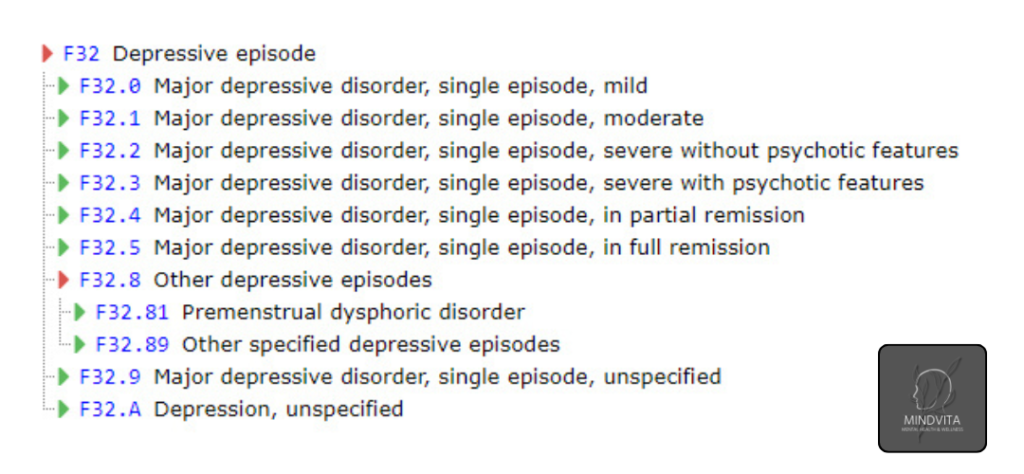
The ICD-10-CM code F32.A is defined as “Depression, unspecified.” This code is used when a patient is presented with symptoms of depression, but the clinical information is not yet available to support a specific type of depressive disorder diagnosis. In icd 10 depression, F32.A is a precursor to a diagnosis code.
This code is especially useful during initial patient visits, follow-up care, or when a full psychiatric evaluation is not readily accessible.
Why Unspecified Depression Is Clinically Necessary
In a real-world clinical setting, not all patients will come in with a comprehensive list of symptoms. F32.A is useful when beginning treatment without over-diagnosing a patient. For example, a patient with symptoms of sadness, insomnia, and fatigue may have over 10 depression symptoms, but the degree or duration of symptoms may still be in question.
In these cases, F32.A is a useful tool for making a diagnosis while gathering more information.
F32.A ICD-10-CM Status and Validity in 2026
Is F32.A a Valid and Billable Code? Yes. As of the 2026 update for ICD-10-CM, F32.A is still:
- Clinically valid
- Billable
- Accepted by CMS, Medicare, Medicaid, and insurance companies
This ensures that icd 10 depression codes are not disrupted in healthcare systems, including primary care, psychiatric care, and telemedicine services.
Why F32.A Remains Relevant
Even with the most contemporary diagnostic tools available at one’s fingertips, depression is a disease that can develop over time. The fact that F32.A is a contemporary code at this point in time illustrates that mental health codes are not always a one-time event.
Common ICD-10 Depression Symptoms
Patients with F32.A are usually presented with icd 10 depression symptoms that include:
- Feeling low or depressed
- Loss of interest in activities that were once enjoyed
- Feeling tired or lacking energy
- Changes in sleep patterns
- Difficulty concentrating
These symptoms can fluctuate and do not necessarily meet the full criteria at the time of the initial presentation.
Effects on Daily Functioning
Even when unspecified, depression can have a significant effect on daily functioning, including work, social, and self-care activities. Early diagnosis with icd 10 depression codes allows the clinician to treat the patient before the onset of the development of worsening symptoms.
Diagnostic Assessment and ICD-10 Depression Criteria
Use of ICD-10 Depression Criteria
ICD-10 depression criteria have very specific guidelines regarding the number of symptoms and the duration of the symptoms. However, F32.A can be used if:
- The duration criteria are not confirmed
- The symptoms are fluctuating in intensity
- There is a lack of information
This will assist in the prevention of overdiagnosis and the recognition of the presence of depressive illness.
Use of Screening Instruments
Screening instruments, such as PHQ-9, are usually used to determine the severity of the symptoms. Screening instruments are useful in the diagnosis of the disease, but it is up to the clinician to use their professional judgment in determining whether to assign F32.A or any other icd 10 depression code.
F32.A vs Other ICD-10 Depression Codes
Major depressive disorder is only diagnosed if the criteria for severity, duration, and functional impairment are met. However, F32.A is used when the above details are not yet known.
Major depressive disorder is a definitive diagnosis, whereas F32.A is a preliminary diagnosis or in the early stages.
Knowledge about Recurrent Depression Coding
A common question asked in clinical coding is: What is the diagnosis code F33 2?
This code is associated with recurrent, severe depressive episodes. The knowledge about What is diagnosis code F33 2? is necessary for the distinction between the first episode or unspecified presentation and recurrent episodes.
The knowledge about What is diagnosis code F33 2? is also necessary for the prevention of undercoding or miscoding of patients with long-standing depression.
Use of F32.A in Different Healthcare Centers
Primary Care and Family Medicine
In primary care and family medicine, patients with emotional distress are commonly seen. Due to time constraints, icd 10 depression is commonly coded as F32.A in the first visit.
Telepsychiatry and Online Mental Health
In telepsychiatry, direct observation is not possible. F32.A is used for responsible coding of depression until a complete diagnostic evaluation is performed.
Documentation Requirements for ICD 10 Depression
Good documentation is necessary for accurate diagnosis and billing. For icd 10 depression, the following should be documented:
Symptoms and quotes from patients
- Duration and precipitating factors
- Functional impairment
- Initial treatment plan
This data is useful for further refinement of the diagnosis.
Common Documentation Errors to Avoid
These may include the continued use of F32.A without reevaluation or the failure to update the diagnosis when the criteria for depression under ICD-10 are clearly met.
At Mindvita, we recommend a check to confirm the correctness of the diagnosis.
Insurance Coverage and Review
Most insurance firms will cover F32.A, especially in the initial treatment process. However, when patients are treated for a long period with unspecified diagnoses, there might be a requirement to give additional details on icd 10 depression.
Transitioning to Specific Diagnoses
Since there is more information about the diagnosis, the codes for Major depressive disorder or other specific depressive disorders should be used.
Public Health Significance of ICD-10 Depression Coding
Unspecified depression diagnoses are also important sources of information. Depression affects more than 280 million people across the world. Accurate ice 10 depression coding is essential for health care policy and billing.

Benefits of Early Coding
Early identification of icd 10 depression coding enables early access to therapy, medication, and support groups.
ICD-11 and Diagnostic Evolution
ICD-11 is being adopted worldwide, but ICD-10-CM is currently in use in the United States. It is important to understand F32.A during this transition phase.
The Role of AI and Data Analytics
Healthcare organizations that use AI are highly reliant on structured diagnostic data. Accurate icd 10 depression coding makes it possible to analyze data, analyze outcomes, and achieve precision psychiatry.
Key Takeaways from Mindvita
F32.A is still applicable and billable in 2026
It facilitates early and ethical diagnosis
The degree of documentation is what makes it possible for long-term diagnosis to be accurate
Re-evaluation results in improved patient outcomes
At Mindvita, we believe that informed diagnosis is equivalent to improved mental health services.
FAQs
When to use F32.A instead of another code for depression?
F32.A is used when the ICD-10 criteria for depression are not fully satisfied but when there are depressive symptoms.
Does F32.A affect insurance coverage for icd 10 depression treatment?
Most insurance companies accept F32.A, but icd 10 depression treatment must be accurately documented.
Is F32.A a code for Major depressive disorder?
No. Major depressive disorder must be distinguished based on severity and duration.
Why is it important to understand What is the diagnosis code F33 2?
What is the diagnosis code F33 2? helps in making the correct diagnoses of recurrent severe depression.
How often should depression diagnoses be reassessed?
It is necessary to periodically reassess depression diagnoses to ensure accurate icd 10 depression coding and treatment.