
An adult ADHD evaluation is mostly a long conversation about your life: how you work, how you lost track of things at nine and again at thirty-four, and what other explanations might fit. There is no scan and no single test. Knowing what the appointment actually involves makes it easier to book one.
At MindVita, adults are evaluated by a psychiatric provider who can also treat what is found, so a diagnosis does not send you somewhere else for the next step. Our providers handle the evaluation and the care that follows, and you can book an appointment when you are ready.
When to Seek an Adult ADHD Evaluation
Consider an evaluation when attention, organization, or follow-through have been a problem for years rather than during one stressful stretch, and when the fallout shows up in more than one place: missed deadlines at work, unpaid bills at home, and relationships worn down by forgetting things. Many adults start wondering after a child or sibling is diagnosed.
The National Institute of Mental Health [1] notes that adults and youth over 16 must show at least five symptoms of inattention, hyperactivity, and impulsivity, or both, and that symptoms must have begun in childhood before age 12. It also points out that stress, sleep disorders, anxiety, and depression can cause similar symptoms.
You do not need to be failing at everything to justify an appointment. Many adults hold demanding jobs while spending enormous effort to stay on top of them. If the effort a task takes feels out of proportion to the task itself, that is worth describing to a provider.
What Happens at an Adult ADHD Evaluation
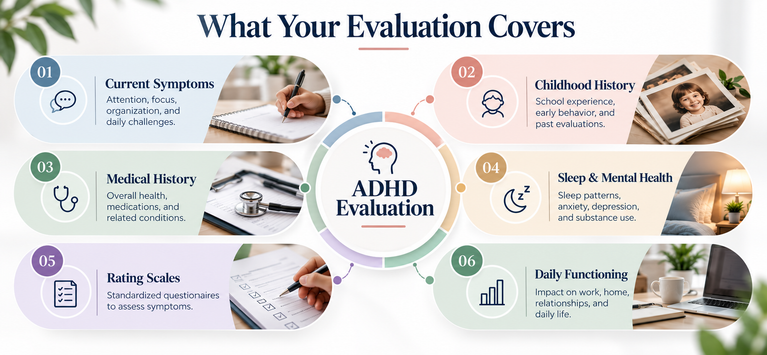
Expect one or two appointments built almost entirely on questions. Your provider will ask about current symptoms, what school and early jobs were like, your medical and psychiatric history, sleep, alcohol use, and how all of it affects work and home. Rating scales may be used, though they support the picture rather than decide it.
The Centers for Disease Control and Prevention [2] describes adult diagnosis as a checklist for rating symptoms alongside a look at your history of behavior and experiences. The provider determines whether symptoms were present before age 12 and may ask permission to gather information from friends and family. A medical and psychological exam may be needed to rule out other causes.
Broken into pieces, the appointment usually covers this ground.
Your Symptoms Right Now
Expect specifics rather than labels. How often you lose things, how long you can read before drifting, what happens to paperwork when it arrives, which tasks you avoid entirely.
What Childhood Looked Like
Report cards, old evaluations, or a parent’s memory all help. If none of that exists, your own recollection of school, homework, and how teachers described you still counts.
Information From Someone Who Knows You
With your permission, a partner, parent, or close friend may be asked what they notice. Outside observation catches patterns that are difficult to see from the inside.
Standardized Rating Scales
You may be handed a questionnaire scoring symptoms against established criteria. It gives your provider a structured measure, but no score on its own produces a diagnosis.
Ruling Other Things In or Out
Sleep problems, thyroid issues, anxiety, depression, and heavy drinking can all mimic ADHD or sit alongside it. Expect questions, and sometimes lab work, about each.
Where the Symptoms Show Up
Diagnosis requires impairment in more than one part of life. Your provider will ask about work, home, money, driving, and relationships rather than focusing on the office alone.
By the end, you should know where things stand: a diagnosis, a different explanation, or a plan to gather more before deciding. Ask what your provider is leaning toward and why. An evaluation that hands you a label with no reasoning behind it has not done much for you.
Do You Need Formal ADHD Testing?
Usually not. ADHD is diagnosed clinically, through history and established criteria, not through a computer task or a brain scan. Formal neuropsychological testing can help when a learning disability, a head injury, or another cognitive concern muddies the picture, but most adults do not need it to get an answer.
CHADD [3], which runs the CDC-funded National Resource Center on ADHD, explains that an adult diagnosis rests on DSM-5 criteria: at least five symptoms, several of them present before age 12, generally corroborated by a parent or another informant, with significant impairment in at least two major settings.
If you have been reading about ADHD tests and quizzes, it helps to know where they sit in all this. MindVita’s guide to ADHD testing covers the different tools available, none of which replaces the conversation described above.
ADHD Evaluation Near Me: Getting Assessed in Northern Virginia
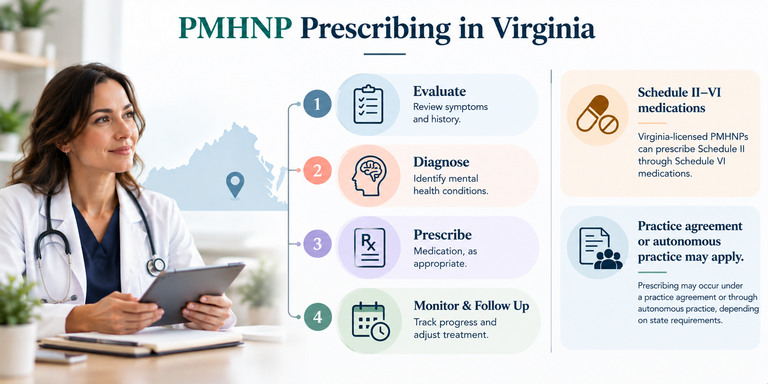
Several kinds of clinicians evaluate adults for ADHD in Virginia: psychiatrists, psychiatric nurse practitioners, psychologists, and some primary care providers. The practical differences are who can prescribe afterward and how long the wait runs. If medication may become part of treatment, starting with someone who can prescribe saves you a second referral.
A few questions sort this out quickly when you call:
- Do you evaluate adults, or mainly children?
- Is the evaluation one appointment or spread across two?
- Will you prescribe if ADHD is diagnosed, or refer me elsewhere?
- Do you want records or rating scales before the first visit?
- Is the appointment in person, by video, or either?
Northern Virginia has no shortage of practices, but waits vary widely between them. If you are calling around Fairfax, Vienna, or Tysons Corner, ask about in-person and video appointments separately, since availability for the two is often different.
What an Adult Diagnosis Can Mean at Work
A diagnosis can open doors at work, and in Northern Virginia it also raises a question about security clearances. Getting treatment for a mental health condition is not automatically disqualifying, and workplace accommodations for ADHD do exist, though what makes sense depends on your job and how much you want to share about why you need them.
The Defense Counterintelligence and Security Agency [4] states in its SF-86 guidance that mental health treatment and counseling, in and of itself, is not a reason to revoke or deny a clearance, and that seeking or receiving care for personal wellness and recovery may count favorably in eligibility decisions. The same guidance does list reportable items, including court-ordered and inpatient care, so read the question itself rather than guessing. Your security officer can answer anything specific to your situation.
Accommodations are a separate conversation with your employer, and they do not require handing over your medical history. Written instructions instead of verbal ones, a quieter workspace, or built-in deadline reminders are common examples. Your provider can document what is needed without describing everything discussed in your appointments.

Book Your Adult ADHD Evaluation With MindVita
Maybe you have taken three online quizzes and still do not know. Maybe you have been told for years that you are smart but scattered, and you have started to believe it is just who you are. Or you keep meaning to call someone and the task slides down the list, which is itself a little on the nose.
At MindVita, an adult ADHD evaluation is done by a psychiatric provider who can also treat what is found, so a diagnosis does not mean starting over somewhere new. Bring whatever history you have, including old report cards if they still exist somewhere. When you are ready, you can book an appointment. One appointment is usually all it takes to stop guessing and start getting answers.
FAQs
Can I be evaluated for ADHD while taking medication for anxiety or depression?
Yes. Tell your provider what you take and when you started it, since some medications affect sleep, focus, or energy. Untreated anxiety or depression can also blur the picture, so the order of treatment sometimes matters. A provider may address the more disruptive condition first and revisit ADHD once things are steadier.
What happens if the evaluation shows I do not have ADHD?
You still come away with useful information. Attention problems have other causes, including sleep disorders, thyroid problems, anxiety, depression, and long stretches of stress, and most of those are treatable. Ask what your provider thinks is driving your symptoms and what the next step for that would be, rather than leaving with nothing.
Do I need a formal diagnosis to get accommodations at work or school?
Usually, yes. Employers and colleges generally ask for documentation from a qualified provider before approving accommodations, and the requirements differ between workplaces and schools. Ask what format and level of detail they need before your appointment so your provider can write the letter correctly the first time instead of revising it later.
How soon after a diagnosis can treatment start?
Often at the same visit, if the provider who evaluated you can prescribe. Some people start medication right away, others begin with skills work, therapy, or changes at work, and some do both together. Expect a follow-up within a few weeks if a medication is started, since early doses often need adjusting.
Should I tell my primary care provider about the diagnosis?
It helps. Your primary care provider tracks your other medications and health conditions, and some ADHD treatments affect blood pressure and sleep. With your consent, the two can share notes so nobody is prescribing without the full picture. A short summary letter is usually enough, and you decide what gets sent.
References
- National Institute of Mental Health (NIMH). “Attention-Deficit/Hyperactivity Disorder: What You Need to Know.”
- Centers for Disease Control and Prevention (CDC). “ADHD in Adults.”
- CHADD, National Resource Center on ADHD. “Diagnosis in Adults.”
- Defense Counterintelligence and Security Agency (DCSA). “SF-86 Guide.”