
A psychiatric nurse practitioner and a psychiatrist can both evaluate you, diagnose you, and prescribe your medication in Virginia. That is the short answer to the PMHNP vs psychiatrist question. Their training differs, and that difference changes things in a handful of specific situations rather than in everyday medication management. Knowing which ones makes the choice simple.
You do not have to settle this question on your own before getting care. At MindVita, Katarina is a psychiatric nurse practitioner who evaluates symptoms, makes diagnoses, and prescribes for ADHD, anxiety, and depression in patients of all ages. One appointment will tell you more about fit than another hour of comparing credentials, and you can book an appointment when you want to start.
PMHNP vs Psychiatrist: What Actually Differs
The real difference is how each one got there. A psychiatrist went to medical school and then spent years in a psychiatry residency. A psychiatric mental health nurse practitioner came up through nursing, earned a graduate degree, and passed a national certification exam in psychiatric care. In the appointment itself, both are doing the same work.
According to the American Psychiatric Association [1], psychiatry residency runs four years after medical school, and psychiatrists can then seek board certification through the American Board of Psychiatry and Neurology. The American Nurses Credentialing Center [2] awards the PMHNP-BC credential after a competency-based exam, and it has to be renewed every five years.
| Psychiatrist | Psychiatric nurse practitioner | |
| Training | Medical school plus a four-year psychiatry residency | Graduate nursing degree with a psychiatric mental health specialty |
| Certification | American Board of Psychiatry and Neurology | PMHNP-BC through the ANCC |
| Diagnoses mental health conditions | Yes | Yes |
| Prescribes in Virginia | Yes | Yes, including Schedule II through VI medications |
| Common settings | Outpatient clinics, hospitals, inpatient and procedural care | Outpatient clinics, hospitals, community and private practices |
Here is the part the table cannot show you. Whether you can be seen when something changes, whether your questions get answered in words you understand, and whether anyone remembers what you tried last time will shape your care far more than the letters after a name.
Can a Psychiatric Nurse Practitioner Prescribe Medication in Virginia?
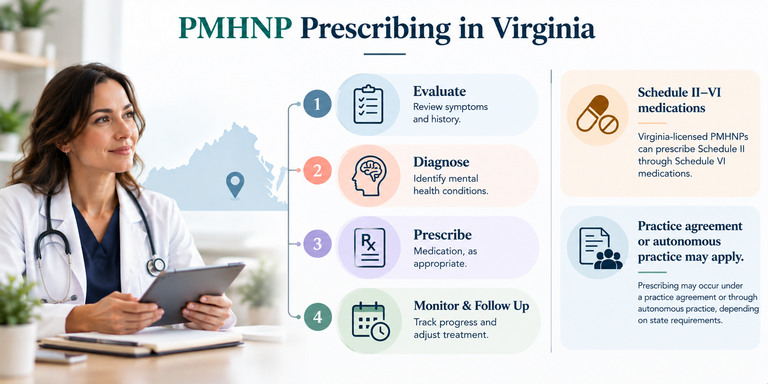
Yes. Nurse practitioners licensed here prescribe psychiatric medication every day, including antidepressants, mood stabilizers, and antipsychotics. Newer ones do it under a practice agreement with a physician. Those who have met the state’s clinical experience requirement can apply to practice autonomously. Either way, the prescription comes from your own provider.
The Virginia Board of Nursing [3] states that nurse practitioners have the authority to prescribe Schedule II through Schedule VI controlled substances and devices. The same part of Virginia law lets one physician serve on a patient care team with up to ten psychiatric mental health nurse practitioners, compared with six in other categories.
People sometimes picture a practice agreement as a physician looking over every prescription. That is not how it works. The agreement spells out what the nurse practitioner can do and gives them someone to call when a case gets tricky. You are unlikely to ever meet that physician.
Can a Psychiatric Nurse Practitioner Prescribe ADHD Medication?
Yes, in Virginia. The stimulants used for ADHD are Schedule II controlled substances, and Schedule II sits inside what the state allows nurse practitioners to prescribe. Individual practices still set their own policies, and telehealth rules for these medications have shifted more than once, so it is fair to ask how a practice handles them.
The Drug Enforcement Administration [4] lists Adderall and Ritalin among Schedule II drugs, the category for medications with accepted medical uses alongside a high potential for misuse and dependence. That is why stimulant prescriptions come with rules other medications do not have, including restrictions on refills.
Of course, the prescription is only part of it. What usually decides whether ADHD treatment works is how closely the dose gets watched in the first couple of months. MindVita’s guide to ADHD medication covers that side of it.
Is a Psychiatric Nurse Practitioner as Good as a Psychiatrist?
This is the question people are usually too polite to ask out loud, so here it is. For common conditions like depression and anxiety, the research so far points to comparable care. That is not the same as saying the two roles are interchangeable everywhere. It means routine evaluation, prescribing, and follow-up hold up well.
A systematic review published in Nursing Outlook [5] looked at 17 studies of nurse practitioner care for patients with anxiety, depression, or substance use disorders. Four high-quality studies found that nurse practitioner care and prescribing were comparable to that of physicians. The authors were also clear that more high-quality evidence is needed.
That last part deserves saying plainly. Most of this research comes from primary care rather than specialty psychiatric practices, and it looks at common conditions rather than complicated ones. For what follows, a psychiatrist’s training really is the better match.
When Seeing a Psychiatrist Makes More Sense
Some situations belong with a psychiatrist, and a good nurse practitioner will tell you that instead of stretching to keep you. Usually it comes down to a diagnosis that will not sit still, a medication that demands close monitoring, or a treatment that happens in a hospital. Being referred is not a demotion.
These are the ones that come up most.
Bipolar Disorder That Is Hard to Pin Down
Mixed states, rapid cycling, and symptoms that keep rearranging themselves. When the diagnosis itself is moving, a psychiatrist’s broader medical training earns its keep.
Clozapine and Other Medications With Heavy Monitoring
Clozapine helps some people when nothing else has, but it comes with ongoing blood work. That usually belongs with a psychiatrist who knows the risks and the monitoring schedule well.
The U.S. Food and Drug Administration [6] removed the clozapine risk evaluation and mitigation strategy program in 2025, but it still recommends that prescribers monitor the absolute neutrophil count on the schedule in the prescribing information because of the risk of severe neutropenia.
ECT and Other Procedures
Electroconvulsive therapy is not something that happens in an office. It involves anesthesia and a hospital team, which puts it in a psychiatrist’s hands rather than an outpatient prescriber’s.
The National Institute of Mental Health [7] describes ECT as a procedure done under short-acting general anesthesia with a muscle relaxant, usually given three times a week until symptoms improve. MindVita’s overview of electroconvulsive therapy explains how it is used.
Serious Medical Complexity
When psychiatric symptoms tangle with unstable medical conditions, complicated drug interactions, or a recent neurological event, a physician’s medical training can change the plan.
Care That Needs a Hospital
Active psychosis, symptoms that are not safe to manage at home, or repeated admissions call for a psychiatric team rather than an outpatient visit every few weeks.
None of that means a nurse practitioner disappears from your care. Plenty of people move back and forth over the years, seeing a psychiatrist through a hard stretch and returning to an outpatient prescriber once things settle. What matters is that somebody is keeping track of the whole story.
How to Choose Between Them for Your Own Care
Start with your own history instead of the credential. If you are looking for help with depression, anxiety, or ADHD and have no history of complicated psychiatric illness, either provider can take this on. If your history includes hospital stays, a stack of medications that did not work, or a diagnosis nobody seems sure about, a psychiatrist is a reasonable place to begin.
Either way, a few questions are worth asking:
- How often will I be seen while we are adjusting medication?
- What should I do if things get worse between visits?
- How do you decide when to refer someone elsewhere?
- How much experience do you have with my condition?
- Who covers your patients when you are away?
Access matters as well. Starting treatment in three weeks with someone you can reach between visits usually helps more than waiting five months for a different credential.

Ask the Questions Before You Choose
You may have read that only a psychiatrist can handle medication properly, then heard the opposite from someone else, and now you are stuck. Meanwhile the symptoms that sent you looking are still there, the waitlists are still long, and another evening spent comparing credentials has not made the choice any clearer.
At MindVita, our psychiatric nurse practitioners do the evaluation, the prescribing, and the follow-up, and they are just as willing to say when a case belongs with a psychiatrist. Knowing where that line sits is part of the job. You can read each provider’s background and focus areas on our team page, then book an appointment if the fit looks right.
FAQs
Can a psychiatric nurse practitioner diagnose me, or does a psychiatrist have to confirm it?
They can diagnose you, and no second signature is needed in Virginia. Diagnosis sits squarely within a psychiatric nurse practitioner’s scope of practice. If your presentation is unusual or the picture is muddy, your provider may still ask a colleague for input, which is what any careful clinician does with a complicated case.
What do the letters PMHNP-BC mean?
Psychiatric mental health nurse practitioner, board certified. The certification comes from the American Nurses Credentialing Center after a competency-based exam, and it has to be renewed every five years. Those letters tell you the person trained specifically in psychiatric care rather than another area of nursing.
Can a psychiatric nurse practitioner treat children and teenagers?
Many can. The across-the-lifespan certification covers childhood through older adulthood, though plenty of providers concentrate on certain age groups anyway. Ask whether a practice actually sees your child’s age range, because real experience with younger patients counts for more here than the credential does.
Will my nurse practitioner consult a psychiatrist if my case gets complicated?
Often, yes. Those working under a practice agreement have a physician available for exactly that, and many who practice autonomously still run difficult cases past colleagues. If your history is complicated, it is a fair thing to ask about before your first visit rather than after.
Can a psychiatric nurse practitioner order lab work?
Yes. Ordering and interpreting labs is part of the job, and psychiatric providers often check things like thyroid function, metabolic panels, or medication levels. Results are usually reviewed with you, and they can be sent to your primary care provider when that keeps everyone on the same page.
References
- American Psychiatric Association. “Choosing a Career in Psychiatry.”
- American Nurses Credentialing Center. “Psychiatric-Mental Health Nurse Practitioner (Across the Lifespan) Certification (PMHNP-BC).”
- Virginia Board of Nursing, Department of Health Professions. “Advanced Practice Registered Nurse.”
- U.S. Drug Enforcement Administration. “Drug Scheduling.”
- Turi E, McMenamin A, Kueakomoldej S, Kurtzman E, Poghosyan L. “The Effectiveness of Nurse Practitioner Care for Patients With Mental Health Conditions in Primary Care Settings: A Systematic Review.” Nursing Outlook. 2023.
- U.S. Food and Drug Administration. “Information on Clozapine.”
- National Institute of Mental Health (NIMH). “Brain Stimulation Therapies.”