
Most people looking up how to switch psychiatrists are not shopping around for fun. Something is not working: the wait for appointments, the fit, a move, and an insurance change. The switch itself is manageable. The part worth planning is making sure your prescriptions do not run out in the middle of it.
At MindVita, people often arrive already on medication, sometimes wanting a second opinion on a plan someone else started. Our psychiatric providers can review what you are taking now and carry your medication management forward from there. If you already know you are leaving your current prescriber, book an appointment before your refills get low.
How to Switch Psychiatrists Without a Gap in Your Medication
Work in this order: book the new intake first, check how much medication you have left, then request your records. Do not give notice to your current prescriber until you have an appointment on the calendar. A gap is easiest to avoid when you know both dates before anything else changes.
Gaps are not only inconvenient. NAMI [1] notes that stopping a medication too quickly can bring on discontinuation symptoms within a few days and that those symptoms can take weeks to go away, which is why any decrease is normally planned with a provider rather than left to a scheduling accident.
Here is what that order looks like in practice.
Book the New Intake First
Waitlists decide your timeline, not you. Once you have a date, you can work backward from it, and everything else, including records and refills, fits around that appointment.
Count Your Refills
Look at the bottle, not your memory. Note the fill date, the days supplied, and how many refills remain, then compare that with your new appointment date.
Ask Your Current Prescriber for a Bridge
If the dates do not line up, ask for enough medication to cover the gap. Many prescribers are willing to do this for a stable patient who is transferring care.
Request Records Early
Records take longer than people expect. Send the request as soon as your appointment is booked so the new practice has something to read before you arrive.
Keep Taking What You Have
Nothing changes until your new provider says so. Keep your current doses and schedule through the transfer, even if you are unhappy with how treatment has been going.
None of this requires a difficult conversation. You do not owe your current prescriber an explanation, a notice period, or a final appointment, and practices handle transfers all the time. What matters is that the medication keeps arriving while the paperwork catches up.
Transferring Psychiatric Care: What Happens to Your Records
Your records do not move on their own. Either you sign a release so the new practice can request them, or you request copies yourself and bring them along. The second route is often faster, and federal law gives you the right to copies regardless of how the relationship ended. Knowing which route you are using keeps the request from stalling.
The U.S. Department of Health and Human Services [2] explains that you have the right to see and get copies of your health information, that your provider normally has up to 30 days to provide it, and that you cannot be denied access for not paying a medical bill.
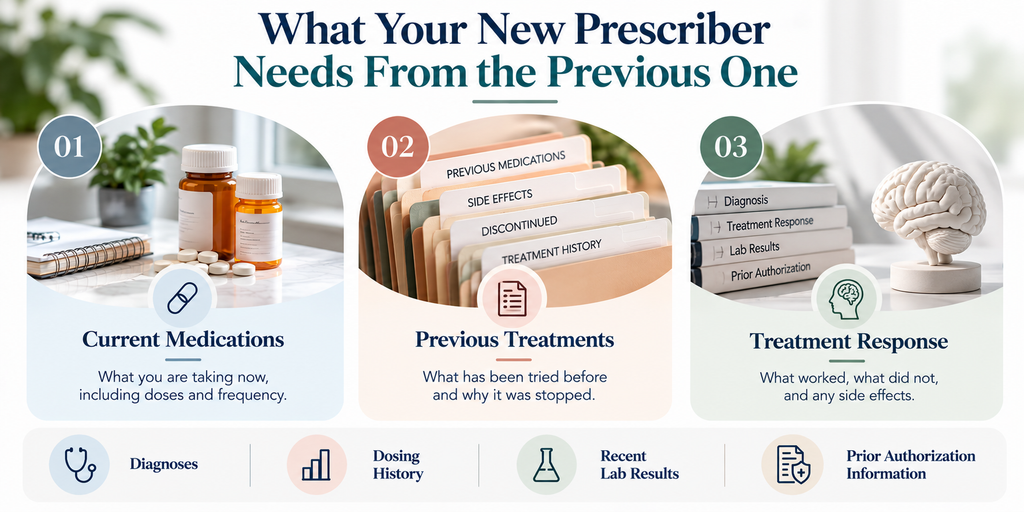
Ask for the useful parts rather than the entire chart: the last year or two of visit notes, your current medication list with doses, what has been tried and stopped, recent lab results, and any prior authorization paperwork. Therapy process notes are treated differently under privacy rules and may not be included. If the practice has a patient portal, some of this may be available for download today.
What Your New Prescriber Needs From the Previous One
Three things matter most: what you are taking now, what has already failed, and why it stopped. A psychiatric provider can work from your current prescriptions alone, but knowing that two medications were abandoned over side effects saves you from repeating them. Diagnoses, dosing history, and recent labs fill in the rest.
Some of it can be verified without waiting on paperwork. The Virginia Department of Health Professions [3] runs the Prescription Monitoring Program, a statewide database of dispensed controlled substances that prescribers use to inform treatment decisions. For controlled medications, that history is often available before your records land.
MindVita’s medication management covers second opinions and diagnostic clarification, monitoring for effectiveness and side effects, pharmacogenetic testing, and supervision if a medication needs to be tapered. Bring whatever you have to the first visit, even if it is only photos of your prescription bottles and a rough timeline in your notes app.
If You Take a Controlled Medication, Start Earlier
Stimulants for ADHD and benzodiazepines need more lead time than other prescriptions. Schedule II medications cannot be refilled, so each month’s supply is a separate prescription, and a new prescriber will normally want to evaluate you before writing one. Starting the switch with three or four weeks of medication left beats starting with two.
Federal regulation 21 CFR 1306.12 [4] prohibits refills on Schedule II prescriptions while allowing a practitioner to issue multiple prescriptions covering up to a 90-day supply, each marked with the earliest date a pharmacy may fill it. That is often how a stable patient gets bridged across a transfer.
Expect questions before anything gets continued. A prescriber taking over a stimulant will usually want to confirm the diagnosis, go through your treatment history, and look at your dispensing record first. MindVita’s guide to ADHD medication covers what that treatment involves day to day.
What the First Visit With a New Prescriber Is Like
Expect a full history rather than a quick handoff. Your new provider will ask what you take, what it has done for you, and what came before it, even if they already have your records. Most of that first appointment goes toward understanding the plan you are on before anyone touches it.
It helps to say plainly why you left. Not out of loyalty or blame, but because the reason usually carries clinical information. Feeling dismissed, never getting an appointment when symptoms flared, side effects nobody adjusted, a dose that never quite worked, all of that shapes what happens next.
You are allowed to disagree, too. If the new plan does not make sense to you, say so while you are still in the room. Transfers sometimes fail for the same reason the last arrangement did: nobody said out loud what wasn’t working.
Make the Switch Without Losing Ground
You have probably been meaning to do this for months. Maybe you are worried about running out of medication partway through, or about explaining to a new provider why you left, or about repeating the trial and error you already went through once. Meanwhile, the refills keep coming, and nothing really changes.
At MindVita, many people come to us already on medication, and the work starts with reading what came before rather than wiping the slate. We can offer a second opinion on your current plan, adjust it where that is warranted, or supervise a taper if something needs to come down. Do it while you still have refills in hand, and you can book an appointment online whenever you are ready.
FAQs
Will my new provider change my medication at the first visit?
Not necessarily. Many psychiatric providers leave things as they are while they get to know your history, particularly if you have been stable. When something does change, it is usually one adjustment at a time so the effect is clear. You can ask directly what the plan is before you leave the appointment.
Can a practice withhold my records if I still owe them money?
No. Federal rules are clear that access to your records cannot be denied over an unpaid bill. A practice may charge a reasonable, cost-based fee for copies, but that is a separate matter from your outstanding balance. If you are refused, put the request in writing and keep a copy of it.
What if my previous provider ignores the records request?
Follow up in writing and hold on to your copy. If the request goes unanswered past 30 days, you can file a complaint with the HHS Office for Civil Rights, which enforces the right of access. In the meantime, your pharmacy can print a complete list of what you have filled.
Can my new prescriber refill my medication before the first appointment?
Usually not. Most psychiatric providers will not prescribe before evaluating you, and for controlled medications, that is generally not appropriate at all. This is exactly why your appointment date and your remaining supply need to line up before you give notice to anyone.
Does switching psychiatric providers reset my insurance prior authorization?
Sometimes. Prior authorizations are often tied to the prescriber who requested them, so a new provider may need to submit a fresh one. Your pharmacy can usually tell you whether an authorization is on file, and starting that paperwork early keeps you from being turned away at the counter.
References
- National Alliance on Mental Illness (NAMI). “Stopping Medications.”
- U.S. Department of Health and Human Services. “Your Right to Access Your Health Information.”
- Virginia Department of Health Professions. “Prescription Monitoring Program.”
- Electronic Code of Federal Regulations. “21 CFR 1306.12: Refilling Prescriptions; Issuance of Multiple Prescriptions.”