

Have you ever noticed that your child struggles to pay attention, has difficulty with social interactions, or shows behaviors that seem similar to both ADHD and autism? Although these are separate neurodevelopmental conditions, they can share symptoms and genetic factors. Understanding their connection can help families recognize concerns early and seek appropriate evaluation and support.
Genetic factors and early detection can provide valuable insights into ADHD and autism, helping you understand why certain symptoms develop and when it may be time to seek professional guidance. At Mind Vita, our psychiatric providers work closely with you to identify concerns, answer questions, and create a plan that supports meaningful progress. Schedule a consultation today and discover the right support for you or your loved one.
Why Do ADHD and Autism Often Occur Together?
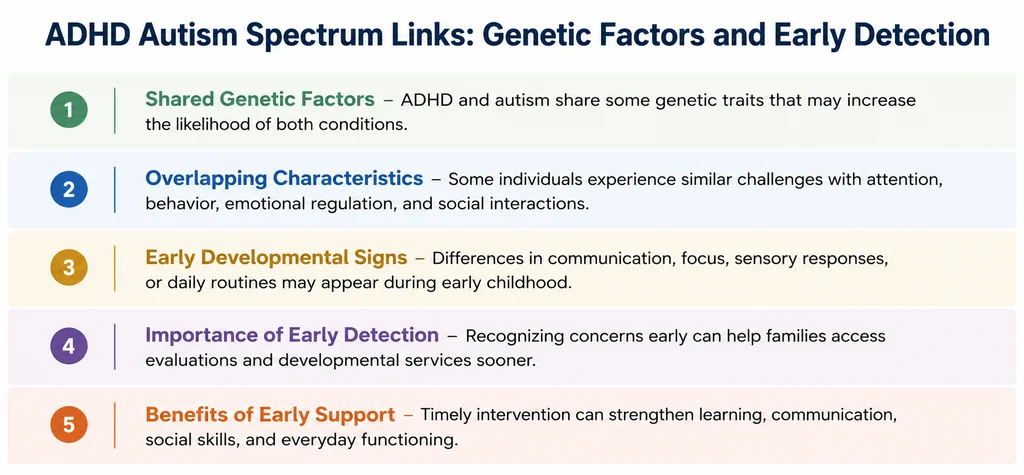
ADHD and autism often occur together because they have overlapping symptoms and shared developmental features. Individuals may experience challenges with organization, emotional control, sensory processing, or adapting to changes in routine. These similarities can appear at the same time, even though each condition has its own features. As a result, healthcare providers frequently assess both conditions when developmental or behavioral concerns affect multiple areas of everyday life.
According to the American Psychiatric Association [1], many individuals diagnosed with autism also meet the criteria for ADHD. Because these conditions can affect multiple areas of daily life, overlapping symptoms may make identification more challenging. Therefore, healthcare providers carefully evaluate both conditions to better understand an individual’s strengths, challenges, and support needs.
What Genetic Factors Increase the Risk of ADHD and Autism?
Genetics plays an important role in both ADHD and autism, and both conditions often run in families. Although no single gene causes either condition, multiple genes involved in brain development and communication may increase the likelihood of developing them. However, genetics alone does not determine whether someone will develop ADHD or autism.
Genetic factors linked to ADHD and autism include:
- Family history of ADHD or autism.
- Inherited changes in multiple genes.
- Genes involved in brain development.
- Differences in how nerve cells communicate.
- Shared genetic traits between both conditions.
- Certain rare genetic variations associated with neurodevelopment.
Genetics can increase the chance of developing ADHD or autism, but they do not determine a person’s future. Environmental and developmental factors also influence how a child grows and behaves. Therefore, having a genetic risk does not mean a diagnosis is certain. Understanding family history and developmental patterns can help identify concerns earlier and support timely evaluation when needed.
Which Early Signs of ADHD and Autism Should Parents Notice?
Early signs of ADHD and autism may include difficulty paying attention, impulsive behavior, delayed communication, limited social interaction, repetitive behaviors, or sensitivity to sounds, lights, and textures. Some children also struggle with following directions, managing emotions, or adapting to changes in routine. Symptoms vary, and some children show characteristics of both conditions.
According to the National Autistic Society [2], early signs of autism may include difficulty understanding social cues, delayed communication, limited social interaction, and strong preferences for routines. Some children also respond differently to sounds, lights, or textures. Recognizing these signs early can help families seek timely evaluation and appropriate support.
How Does Early Detection Improve ADHD and Autism Outcomes?
Early detection allows children to receive appropriate support before developmental challenges become more difficult to manage. Early intervention can improve communication, learning, social skills, and daily activities. It also helps parents better understand their child’s needs and take steps that support healthy growth and long-term development.
Earlier Access to Intervention
Early detection helps children access services and therapies sooner. As a result, support can begin during key stages of development when the brain is growing rapidly, making it easier to strengthen communication, learning, social, and daily living skills.
Better Communication and Social Skills
Early intervention can strengthen communication, social interaction, and relationship-building skills. As children learn these skills sooner, they may feel more confident participating in daily activities, forming friendships, and engaging successfully at home, school, and in community settings.
Improved Learning and Daily Functioning
Identifying concerns early can help children build skills needed for learning, organization, and daily activities. Early support may improve classroom performance, strengthen independence, and make it easier to manage responsibilities and routines in everyday life.
Stronger Long-Term Outcomes
Early support can encourage healthy development and greater independence over time. It also helps children build important strengths that can improve success in school, support positive relationships, and make everyday tasks easier to manage as they grow.
According to a review published in the Journal of Behavioral and Brain Science [3], early identification and intervention can improve communication, learning, social development, and overall quality of life for children with neurodevelopmental conditions. Early support also helps families better understand their child’s needs and make informed decisions about long-term care.
What Is the Difference Between Autism and ADHD During Evaluation?
ADHD and autism are evaluated differently because they affect people in different ways. During an evaluation, psychiatric providers look at attention, activity levels, social skills, communication, behavior, and developmental history. ADHD evaluations focus mainly on attention, impulsivity, executive functioning, and hyperactivity. In contrast, autism mainly affects social communication, interactions with others, and certain behavior patterns. However, some individuals may show signs of both conditions.
Providers also gather information from parents, caregivers, teachers, or the individual and may use screening tools and behavioral assessments. Combining this information helps determine whether symptoms are related to ADHD, autism, or both conditions, allowing providers to recommend appropriate treatment, ongoing support, and guidance based on each person’s needs.

Start Building a Clearer Path Forward for ADHD and Autism with MindVita
You may notice challenges with attention, social interactions, or daily routines in yourself or your child without knowing the cause. Over time, these difficulties can affect learning, relationships, and self-confidence while creating stress at home or school. When symptoms overlap, it can be difficult to know where to begin.
At Mind Vita, our psychiatric providers provide comprehensive evaluations to better understand developmental patterns, attention concerns, and social challenges. We then create personalized treatment plans that help you understand your child’s strengths, access appropriate support, and build practical strategies for long-term success. Contact us today and get the guidance you need to better understand ADHD and autism.
FAQS
Can Genetics Predict ADHD and Autism Risk?
Yes, genetics can help show whether a person has a higher chance of developing ADHD or autism because these conditions often run in families. However, genes alone cannot predict who will have them. Psychiatric providers also look at a child’s behavior, development, and symptoms over time before making a diagnosis.
At What Age Can ADHD and Autism Be Identified?
Autism signs can often be identified between 18 and 24 months of age, while ADHD symptoms usually become clearer between ages 4 and 12 years. However, every child develops differently. Therefore, healthcare providers monitor behavior, communication, and attention skills over time before making an accurate diagnosis.
Why Is Early Detection Important for ADHD and Autism?
Early detection helps children receive support during important stages of brain development, especially before age five. As a result, they can build stronger communication, learning, and social skills. It also helps families access resources sooner, reducing challenges at home and school while improving long-term outcomes and daily functioning.
Does having a parent with ADHD increase the risk of autism in a child?
Yes, having a parent with ADHD may increase a child’s likelihood of developing autism because both conditions share some genetic factors. However, this does not mean autism will occur. Signs may become noticeable during the toddler or preschool years, which is why regular developmental monitoring and early screening are important.
Are boys and girls affected differently by ADHD and autism?
Yes, boys and girls can experience ADHD and autism in different ways. Boys often show clear signs, such as high activity levels or repetitive behaviors, during the early years. However, girls may hide their struggles or show less obvious symptoms. As a result, many girls are identified later, often during school-age years or adolescence.




3 Responses