

FMLA for mental health works the same way as FMLA for a physical illness. The condition must meet the law’s definition of a serious health condition, you must clear the eligibility tests, and a treating provider must complete a certification. The leave itself is unpaid and job-protected.
Most of the delay in this process happens at the paperwork stage. At MindVita, completing FMLA certification for established patients is an office policy rather than a favor to ask for, and your prescriber is a psychiatric nurse practitioner (PMHNP-BC) in Vienna or available by telehealth across Virginia. What follows is general information and not legal advice. You can book an appointment about leave paperwork and bring whatever your employer has already sent you.
Can You Take FMLA for Mental Health?
Yes, when it meets the statutory definition. The law does not keep a list of qualifying diagnoses, and it does not treat mental health differently from physical health. What matters is whether your condition needs hospital admission or ongoing treatment and whether it stops you from performing the essential duties of your job.
The U.S. Department of Labor [1] states that mental and physical health conditions are both serious health conditions under the FMLA when they require inpatient care or continuing treatment by a health care provider. Inpatient care means an overnight stay. Continuing treatment reaches conditions that incapacitate someone for more than three consecutive days and require ongoing treatment, and it also reaches chronic conditions such as anxiety, depression, or dissociative disorders, which the department describes as causing occasional incapacity and requiring treatment at least twice a year.
That chronic condition route fits most people reading this. You are not off work for a solid two weeks. You are losing a day here and a morning there, with appointments in between, and that pattern qualifies on its own terms.
Who Is Eligible for FMLA Leave?
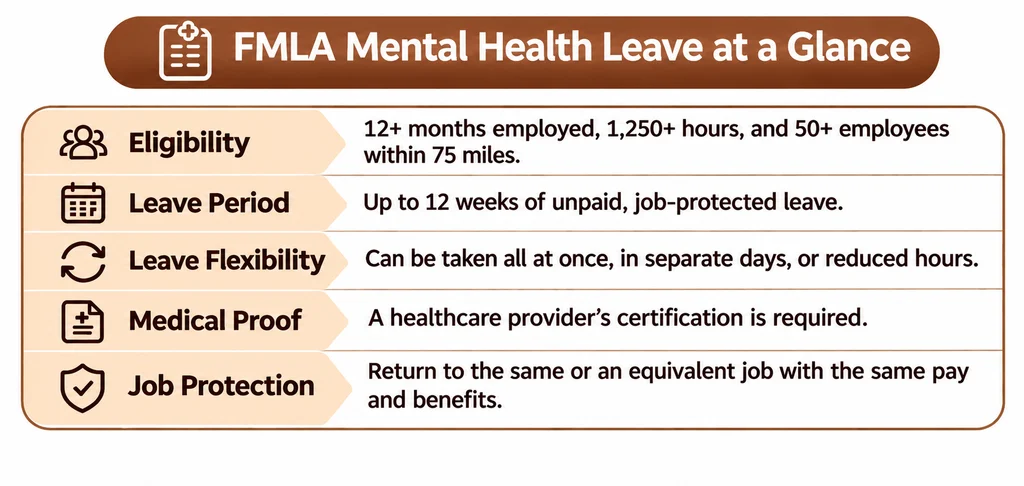
Three tests, and you have to pass all of them. Eligibility turns on how long you have worked for the employer, how many hours you logged in the last year, and how many people that employer has near your worksite. Plenty of people who genuinely need the leave do not qualify, so check this early.
The same guidance [1] sets the three tests for the employee, and the department’s general FMLA guidance [2] adds what the leave is worth once you clear them. Treat the tests as a checklist and not a sliding scale:
- At least 12 months of employment with that employer
- At least 1,250 hours of service for the employer during the 12 months before the leave
- A worksite where the employer has at least 50 employees within 75 miles
- Up to 12 workweeks of leave in a 12-month period once you do qualify
- Unpaid by default, though employer-provided paid leave can run at the same time where the employer’s own policy covers the reason
Miss one of the three, and this is not your route better known now than after you tell a manager you are taking twelve weeks. Company leave policies, accrued paid time off and an accommodation request are what remain, and HR is who can tell you which of those your workplace carries.
Continuous or Intermittent Leave: Which One Applies?
Whichever your treatment pattern requires, which makes it a clinical question before it is an administrative one. The leave can run as one unbroken block, as separate days and part-days spread over months, or as a shorter working week. Mental health leave more often takes the second shape than the first.
The general guidance confirms that employees may take the leave all at once or, when medically necessary, in separate blocks of time or by reducing the hours they work each day or week. The phrase “medically necessary” is included because your provider’s certification, not your own preference, determines which pattern applies to you.
The intermittent version is harder to administer and easier to live with. Your employer will want an estimate of how often this happens and how long an episode lasts, which means predicting something unpredictable. An honest range serves you better than a precise figure nobody can stand behind.
The Certification Form and What Your Provider Fills In
Medical facts, dates, and functional limits, and not a diagnosis unless your provider chooses to give one. The form asks when the condition began, how long it is expected to last, what you cannot currently do, and for intermittent leave, how often absences are likely. Your employer may require it before approving anything.
Fact Sheet 28G [3] lists what an employer may ask the provider to supply: contact details, the date the serious health condition began and how long it will last, appropriate medical facts such as symptoms, hospitalization or doctor’s visits, and your functional limits, plus the expected frequency and duration of absences when the leave is intermittent. It adds that the health care provider may, but is not required to, provide a diagnosis.
The rules around that form are more protective than most people expect.
Fifteen Calendar Days to Return It
You generally have 15 calendar days from the employer’s request, and the guidance expects a diligent, good-faith effort to meet that rather than a perfect turnaround.
Seven Days to Fix an Incomplete One
If your employer states in writing that the certification is incomplete or insufficient, you get seven calendar days in most circumstances to supply whatever is missing.
Your Supervisor Cannot Call Your Provider
A human resources professional, leave administrator, or management official may contact the provider to authenticate or clarify the form, and your direct supervisor may never do it.
Recertification Has Limits
Your employer may seek recertification no more often than every 30 days and only in connection with an absence, and every six months regardless of the condition.
The form itself is optional. The department’s certification forms page [4] calls the WH-380-E an optional tool for an employee’s own serious health condition, says employers may use their own version as long as it collects the same information, and says a complete certification must be accepted regardless of format. For patients we already treat, our medication management appointments are where it gets filled in.
Talking to HR and Returning to Work
Tell them enough to recognize it as FMLA-qualifying, and give as much notice as the situation allows. You do not have to name the law, name a diagnosis, or justify yourself to your manager. When you return, the job you return to must be the one you left or its equivalent.
The department’s guidance on employee notice [5] asks for at least 30 days’ advance notice when the leave is foreseeable and as soon as possible and practical when it is not. The same sheet notes that an employee does not have to mention the FMLA to be protected under the law, while expecting a specific reference to the qualifying reason for later leave taken for the same thing. What you do owe your employer is enough information for it to know the leave may be covered.
On the return side, the general guidance gives you the right to go back to the same job or an equivalent one, with the same pay, benefits, and terms, and keeps your group health coverage running while you are out. If your workplace has a fitness-for-duty requirement, ask about it before your last day, not the night before you go back.
The Paperwork Is the Last Step, Not the First
Most people arrive at this in the wrong order. The employer asks for a form, the form needs a treating provider, and there has not been one for months, because whatever made work impossible also made booking an appointment impossible. Somewhere in the middle of that, a fifteen day clock starts running.
At MindVita the certification is not something done at arm’s length. A psychiatric nurse practitioner has to treat you to complete it honestly, which is why the appointment comes before the form, not after, and we complete this paperwork for our established patients as office policy. We cannot certify for anyone we have not assessed, and no practice should.
Our office is at 8000 Towers Crescent Drive, Floor 13, Vienna, VA 22182, and we offer telehealth everywhere else in Virginia. Questions about your legal rights belong with an employment lawyer or the Wage and Hour Division, but the clinical half is ours. Bring the form and the dates you have already missed, and book an appointment about leave paperwork.
FAQs
What if I have worked there less than a year?
Then this route is closed to you for now, and the question becomes what your workplace offers instead. Sick leave, short-term disability, and an unpaid leave policy of the employer’s own are the common substitutes, and some employers are more generous than the law requires. Ask HR what applies to you.
Can I take more than 12 workweeks if I am not ready to come back?
Not under the FMLA, which caps the entitlement at twelve workweeks. Anything beyond that depends on your employer’s policies or other law, so raise the question with HR before the protected weeks run out rather than afterward, because the options narrow considerably once the leave has lapsed and you are no longer covered.
Should the form go to my therapist or my prescriber?
Whoever is treating the condition you are taking the leave for and can describe your limits. If you see both, the person managing your medication and the person doing the therapy each hold part of the picture, so ask the practice which one completes it. Asking when you book saves the form a round trip.
What if my employer denies the leave?
Ask for the reason in writing, because the reason tells you which problem you are actually solving. A certification the employer calls incomplete has a short window to fix. An eligibility shortfall does not, and you can raise a denial you believe is wrong with the Department of Labor’s Wage and Hour Division or take it to an employment attorney.
Can I use FMLA while a medication is being started or changed?
Yes, where the condition qualifies, and your provider certifies the need. The first weeks on a new medication are a common period for absences, and that is the sort of pattern the frequency and duration part of the form exists to describe. Tell your prescriber you will need the form before the change rather than after it.
References
- U.S. Department of Labor, Wage and Hour Division. “Fact Sheet #28O: Mental Health Conditions and the FMLA.” https://www.dol.gov/agencies/whd/fact-sheets/28o-mental-health
- U.S. Department of Labor, Wage and Hour Division. “Fact Sheet #28: The Family and Medical Leave Act.” https://www.dol.gov/agencies/whd/fact-sheets/28-fmla
- U.S. Department of Labor, Wage and Hour Division. “Fact Sheet #28G: Certification of a Serious Health Condition under the FMLA.” March 2025. https://www.dol.gov/agencies/whd/fact-sheets/28G-fmla-serious-health-condition
- U.S. Department of Labor, Wage and Hour Division. “FMLA Certification Forms.” https://www.dol.gov/agencies/whd/fmla/forms
- U.S. Department of Labor, Wage and Hour Division. “Fact Sheet #28E: Employee Notice Requirements under the Family and Medical Leave Act.” https://www.dol.gov/whd/regs/compliance/whdfs28e.htm