

OCD medication usually means an SSRI, often at a higher dose and for longer than the same drug would be used for depression. It tends to reduce how loud and how frequent obsessions and compulsions are without removing them altogether, and it is usually paired with therapy rather than used on its own.
Deciding whether to try medication is its own step, separate from deciding it has failed before starting. At MindVita, prescribers are psychiatric nurse practitioners with the PMHNP-BC credential, available in Vienna or by video anywhere in the state. You can book an OCD medication evaluation and bring the history with you.
How Does Medication Help OCD?
By turning the volume down, not by switching the thoughts off. Medication tends to make obsessions less sticky and compulsions easier to resist, so the same intrusive thought arrives with less force behind it. Full remission on medication alone is uncommon, which shapes what to expect from it at the start.
A Cochrane review of SSRIs against placebo in OCD [1] pooled 17 trials and 3,097 adults. People taking an SSRI were close to twice as likely to reach a clinical response, defined as a 25 percent or greater reduction in symptoms, and the average reduction in symptom scores was modest rather than dramatic. The authors noted that longer-term effectiveness and tolerability have not been established.
“Modest” is the honest word for it. A quarter off a symptom score is the difference between compulsions running your evening and compulsions being an argument. You can sometimes win a real change, but not the same as the thoughts stopping. That gap is why medication management and therapy are usually set up together.
What Are the Medication Options for OCD?
There is no single best medication for OCD, and the honest answer to that question is that the choice is individual. Several SSRIs carry OCD approval, clomipramine is the older option, and the comparative evidence does not separate them on effectiveness. What decides it is everything the trials could not measure about you.
A network meta-analysis in Focus [2] brought together 64 trials and 7,302 adults, comparing all six SSRIs, clomipramine and venlafaxine, against each other and against placebo. It reported no evidence that one drug is better than the others, with clomipramine showing a trend toward a larger effect that did not reach statistical significance.
Which leaves the choice resting on things that are specific to you.
What You Have Tolerated Before
A drug that made you unbearably nauseated last time narrows the list usefully, and one that helped a relative is weaker evidence than people assume.
Side Effect Profiles Differ
The evidence puts the SSRIs close together on benefit and further apart on side effects, so tolerability often decides which one a prescriber reaches for first.
Clomipramine Sits Behind the SSRIs
Older, effective, and harder to tolerate, which is why guidance puts an SSRI first and keeps clomipramine for when the SSRIs have not done enough.
Other Medications You Take
Interactions matter more here than in many conditions, because some of these drugs change how the liver handles other prescriptions you may already be taking.
Augmentation if the First Try Falls Short
If an adequate trial has not delivered, guidance favors adding something to what is working rather than abandoning it and starting again from the beginning.
None of this is a shortlist to bring in and ask for by name, though saying what you are hoping for is useful. The prescriber is weighing your history against side effect profiles, and that is a conversation rather than a lookup. Bringing the detail speeds it up considerably.
How Soon Does It Work, and What Are the Side Effects?
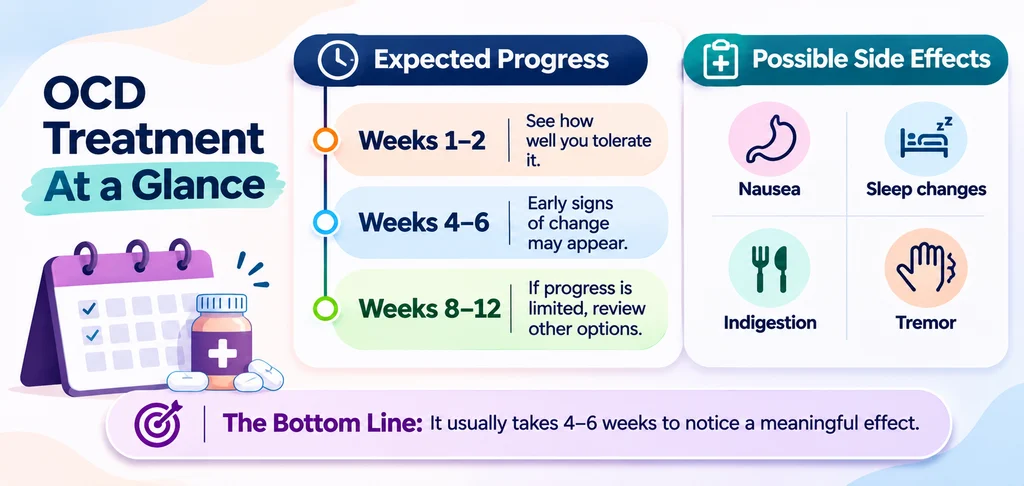
Longer than you want, and side effects tend to show up well before any benefit does. OCD responds more slowly than depression does, so judging a medication at two weeks tells you almost nothing except whether you can tolerate it. That lag is what makes the first month so discouraging.
The APA practice guidance on OCD [3], summarized in American Family Physician, puts numbers on the wait. Substantial improvement is often not apparent until four to six weeks, some people take ten to twelve weeks, and a trial should run at least six weeks before it is judged. If there has been no good response after eight to twelve weeks, that is the point to consider changing something.
The FDA prescribing information for fluvoxamine [4], one of the SSRIs approved for OCD, lists nausea, sleepiness, trouble sleeping, weakness, nervousness, indigestion, sexual side effects, sweating, loss of appetite and tremor among the most frequent. The label also carries a boxed warning about suicidal thinking in children and young adults, and tells prescribers to reduce the dose gradually instead of stopping abruptly.
How Does Medication Fit With ERP Therapy?
Medication makes exposure work survivable, and exposure makes the gains hold. The usual sequencing is to start one and add the other, not to run both from a standing start, and which comes first depends on how severe things are, what previous treatment achieved, and what is actually available to you.
Exposure and response prevention is the therapy guidance points to first for OCD, and it asks you to sit with the discomfort without performing the compulsion. Doing that at full symptom severity is a tall order, which is where the sequencing question actually comes from.
Coordination matters more than order. Your prescriber should know you are doing exposure work and roughly where you are in it, because a dose change landing in the middle of a hard exposure block is better timed deliberately than by accident.
When Should You Ask for an Evaluation?
When the compulsions are taking time, you cannot get back. An hour a day is the rough threshold clinicians use, but a more useful test is whether you are rearranging your life to avoid triggers and whether the people close to you have started participating in the rituals as well.
- Rituals that take an hour or more on an ordinary day
- Routes, people, or places you avoid to keep the thoughts away
- Family members pulled into checking or reassuring you
- Intrusive thoughts that feel dangerous to have, including violent or sexual ones
- A previous SSRI that was stopped early because of side effects
Noticing several of these is a reason to raise it with a clinician, not a diagnosis in itself. Intrusive thoughts in particular frighten people into silence, and the content of them, however violent or shameful it feels, is not evidence about who you are. It is often the thing people keep back from the one person who could treat it.
Saying the Thoughts Out Loud Is the Hardest Part
Most people with OCD wait a long time before asking, and the waiting is usually about the content of the thoughts more than how severe they have become. Describing an intrusive thought to a stranger can feel like confessing to something, which is exactly backward, and it keeps people quiet for years.
At MindVita, the thought you are about to describe is one a psychiatric nurse practitioner has heard before and treats as a symptom with a name. The appointment covers what has been tried, what it cost in side effects, and whether medication belongs alongside exposure work or ahead of it. The office is at 8000 Towers Crescent Drive, Floor 13, Vienna, VA 22182. Everything outside Vienna runs on video. Book an OCD medication evaluation and say it to someone trained to hear it.
FAQs
Does medication work if my OCD is mostly intrusive thoughts with no visible rituals?
Yes. Obsessions without visible compulsions still count as OCD, and the mental rituals that go with them, the checking and reviewing you do silently, respond to the same medications. The absence of handwashing or lock checking is not a reason to assume medication has nothing to offer, and prescribers see this presentation often.
How long does OCD medication usually continue?
Longer than most people expect. Guidance suggests continuing for one to two years after symptoms respond before considering any taper, and tapering is done gradually while watching for symptom return. Stopping early is one of the more common reasons symptoms come back, which makes it a conversation to have, not a decision to make alone.
Will describing violent intrusive thoughts put me at risk?
No. Violent, sexual, and blasphemous intrusive thoughts are a recognized feature of OCD, and clinicians are trained to tell them apart from intent. What distinguishes an obsession is precisely that it horrifies the person having it. Describing them accurately helps the assessment, and holding them back slows it down considerably.
Does OCD medication change your personality?
Not in the way people fear. The common complaint is emotional blunting, a sense of feeling less of everything, which some people notice, and others do not. It often eases with a dose change, so it is worth telling your prescriber rather than quietly stopping the medication on your own.
Why am I being prescribed an antidepressant for OCD?
Because the drugs that work for OCD happen to be the same ones that work for depression, which says more about how they act on serotonin than about what either condition is. Being offered one is not a sign that your prescriber thinks the real problem is depression, and the label for several of them names OCD directly.
References
- Soomro GM, Altman DG, Rajagopal S, Oakley Browne M. “Selective Serotonin Re-uptake Inhibitors (SSRIs) Versus Placebo for Obsessive Compulsive Disorder (OCD).” Cochrane Database of Systematic Reviews. 2008. https://www.cochrane.org/evidence/CD001765_selective-serotonin-reuptake-inhibitors-ssris-versus-placebo-obsessive-compulsive-disorder-ocd
- Skapinakis P, Caldwell D, Hollingworth W, et al. “Pharmacological and Psychotherapeutic Interventions for Management of Obsessive-Compulsive Disorder in Adults: A Systematic Review and Network Meta-analysis.” The Lancet Psychiatry. 2016;3(8):730-739. Reprinted in Focus, American Psychiatric Association Publishing. https://psychiatryonline.org/doi/full/10.1176/appi.focus.19402
- “APA Releases Guidelines on Treating Obsessive-Compulsive Disorder.” American Family Physician. July 2008. https://www.aafp.org/pubs/afp/issues/2008/0701/p131.html
- U.S. Food and Drug Administration. “Fluvoxamine Maleate Prescribing Information.” DailyMed, National Library of Medicine. https://dailymed.nlm.nih.gov/dailymed/drugInfo.cfm?setid=6eeb14df-6fcf-a737-5359-5744eb4accea