

High-functioning anxiety describes someone who meets their responsibilities while feeling persistently anxious underneath. It is not a formal diagnosis, and that is part of the problem, because people who keep performing often wait years before mentioning it. The signs are real, and so is the cost of carrying them quietly.
If you have been managing like this for a while, a conversation with a psychiatric provider is a reasonable next step rather than an overreaction. At MindVita, we work with people whose anxiety has never stopped them functioning and has still been exhausting to live with. You can book an appointment when it suits you.
What Is High Functioning Anxiety?
It is an informal term, not a clinical one. People use it to describe living with ongoing anxiety while still holding down a job, raising children, and meeting deadlines. No diagnostic manual lists it, so a provider starts by looking at which recognized condition, if any, fits what you are describing.
The National Institute of Mental Health [1] lists generalized anxiety disorder, panic disorder, social anxiety disorder, and phobia-related disorders as the recognized anxiety disorders. High functioning anxiety is not among them. It also draws a line between ordinary worry and a disorder, noting that for people with these conditions the anxiety does not go away, is felt in many situations, and can get worse over time.
That last point is the one worth sitting with. If the term describes you, it probably points toward one of those conditions rather than ruling anything out, and the fact that you are still managing does not make the case for an assessment any weaker.
What Are the Signs of High Functioning Anxiety?
Constant low-level worry, trouble switching off, irritability that surprises you, physical tension, and a need to over-prepare are the common high-functioning anxiety symptoms. None of them confirms anything on its own. What matters is how many have persisted, for how long, and what they are quietly costing you day to day.
The GAD-7 [2], a seven-item screening scale validated in 2,740 primary care patients, asks about feeling nervous or on edge, not being able to stop or control worrying, worrying too much about different things, trouble relaxing, restlessness, becoming easily annoyed or irritable, and feeling afraid as if something awful might happen.
Those items turn up in daily life in fairly specific ways.
- Worry That Runs in the Background: You can work, drive, and hold a conversation while a separate track keeps running quietly through everything that might go wrong later in the week.
- Trouble Switching Off: Evenings and weekends do not feel like rest, because the part of you that monitors for problems stays on even when there is nothing to do.
- Over-Preparing for Ordinary Things: You rehearse routine calls, reread sent emails, and arrive early for everything, which looks like diligence from outside and feels like insurance against something going wrong.
- Irritability That Stops You Off Guard: Small interruptions produce a reaction out of proportion to the interruption, usually with people you are closest to rather than the ones you are performing for.
- Physical Tension You Stop Noticing: Shoulders, jaw, and stomach carry it, and many people only register how much tension they were holding once something finally forces them to stop for a while.
Any one of these can have another explanation, and a single stressful month is not the same as a pattern. The question a provider works through is whether these have been steady for months, whether they cluster together, and whether they are quietly shaping decisions you would otherwise make differently.
Why Does Anxiety Stay Hidden in People Who Seem to Be Coping?
Because the usual signal that something is wrong is a visible drop in performance, and that signal never arrives. Hidden anxiety stays hidden partly because the person managing it is reluctant to name something they are technically getting away with, and partly because nobody around them thinks to ask about it.
The GAD-7 validation study [2] suggests the cost shows up whether or not anyone sees it. Across the patients studied, self-reported disability days over the previous three months rose steadily with anxiety severity, from about four days in the lowest group to around eleven at moderate severity and nearly seventeen at the highest.
Those are averages rather than anything to apply to yourself, and the point is not the exact figures. It is that functioning and feeling well are not the same measurement. You can hold the first steady for a long time while the second slips, and only the first is visible to other people.
What Causes High Functioning Anxiety?
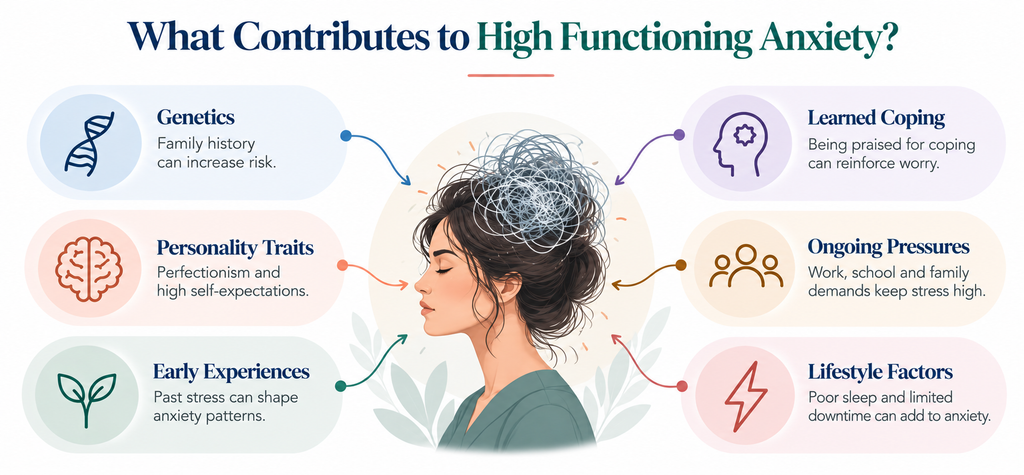
There is rarely a single cause. Family history, temperament, early experiences, and long stretches of sustained pressure tend to combine, and the high functioning part is usually learned rather than innate. Someone who was praised for coping young often keeps coping because it worked and because nothing suggested another option.
The World Health Organization [3] notes that anxiety symptoms often begin in childhood or adolescence and continue into adulthood, and that more women than men are affected. It puts the global figure at around 470 million people, or roughly 5.8 percent of the population, which makes anxiety disorders the most common mental health conditions.
The childhood onset detail explains a lot about why this is hard to spot in yourself. If the worry has been there since school, there is no before to compare it against, and it registers as a personality rather than as something that started.
What Does Treatment Usually Involve?
Talking therapy, medication, or both, depending on how severe the symptoms are and what you would prefer. For anxiety that has not stopped you functioning, therapy is often where people start. Medication becomes part of the conversation when symptoms are more severe or when therapy on its own has not been enough.
WHO [3] describes psychological interventions as essential, with the strongest evidence behind approaches based on cognitive behavioral therapy, including exposure therapy. It lists SSRIs as useful for adults, and it notes that benzodiazepines are generally not recommended because of their potential for dependence and their limited long-term effectiveness.
In practice that means psychotherapy and medication management are often arranged alongside each other rather than treated as a choice between two camps. Adding medication to therapy you are already doing does not mean the therapy failed, and the two are frequently combined because they work on different parts of the problem.
When Should You Get Help for Anxiety?
When it has lasted months rather than weeks, when it is affecting sleep, relationships, or how much you enjoy anything, or when the effort of managing it has become its own full-time job. You do not need to be struggling visibly, and you do not need a diagnosis or a label before you ask.
Most people in this position wait a long time. WHO [3] estimates that only about one in four people who need treatment for an anxiety disorder actually receive any, and it names low awareness of anxiety as a treatable condition, along with stigma, among the reasons. Waiting is the norm rather than the exception.
A scheduled appointment is not the right route for everything. If you are having thoughts of suicide or self-harm, the 988 Suicide and Crisis Lifeline [4] can be reached by call, text, or online chat at any hour, and it is free and confidential. Call 911 if you or someone else is in immediate danger.
Working out when to get help for anxiety is less about reaching a threshold and more about how long it has gone on and what it is taking from you. If you are simply tired of running at this level, that is a reasonable enough reason to book.
You Do Not Have to Be Falling Apart to Get Help
Maybe you have been meaning to mention this for two years and keep deciding it is not bad enough. Maybe you only notice how much you are carrying on the drive home. Or you have been told you are a worrier for so long that it stopped sounding like something treatable.
At MindVita, an assessment for high-functioning anxiety starts from how you are actually living rather than from whether you have fallen behind. Care is provided by board-certified advanced practice providers rather than psychiatrists, and you can see who you would be working with before you commit to anything. We see patients at our Vienna office, a short drive from Tysons, or by secure video, depending on where your provider is licensed. You can book an appointment and bring whatever you have been sitting on. You do not need to have a word for it before you come in.

FAQs
Is it still anxiety if I do not feel anxious, only tense and busy?
It can be. Many people describe pressure, tension, or a need to keep moving rather than fear, and some only recognize the anxious part in hindsight. A provider asks about the physical and behavioral side as well as the emotional one, so bring what you actually notice rather than what you think counts.
Does a questionnaire score decide the diagnosis?
No. Screening scales flag who should be looked at more closely and give a rough sense of severity, but they are not diagnostic on their own. A score sits alongside your history, how long symptoms have lasted, and what else could explain them. Your provider should talk you through what yours means.
Should I tell my employer?
That is your decision, and nothing requires it. Some people find a conversation about workload or scheduling helps, while others would rather keep treatment separate from work entirely. If you need time for appointments, you can usually arrange that without naming the reason. Discuss it with your provider before you decide.
What if the anxiety is really just my job?
Then that is useful information, not a reason to skip the appointment. A demanding role can produce genuine symptoms, and a provider can help you work out whether the pattern lifts when the pressure does. If it follows you into vacations and weekends, the job is probably not the whole story.
Will I be expected to start medication at the first appointment?
No. A first appointment is mostly assessment, and medication is one option among several rather than a default. You can say upfront that you would prefer to start with therapy or that you want to think about it. A provider who will not discuss that is not the right fit.
References
- National Institute of Mental Health (NIMH). “Anxiety Disorders.” https://www.nimh.nih.gov/health/topics/anxiety-disorders
- Spitzer RL, Kroenke K, Williams JBW, Löwe B. “A Brief Measure for Assessing Generalized Anxiety Disorder: The GAD-7.” Archives of Internal Medicine. 2006. https://pubmed.ncbi.nlm.nih.gov/16717171/
- World Health Organization. “Anxiety Disorders.” https://www.who.int/news-room/fact-sheets/detail/anxiety-disorders
- 988 Suicide & Crisis Lifeline. Official website. https://988lifeline.org/