

PMDD treatment usually combines an SSRI antidepressant, talking therapy, or both, with hormonal options considered for some people. It is a recognized condition with established guidance behind it, which matters if you have been told that severe premenstrual mood symptoms are just something you have to manage on your own.
If that pattern sounds familiar, it is worth having someone look at the whole year rather than judging it one cycle at a time. At MindVita, you can go through recurring mood symptoms and the treatment options that may suit you with a psychiatric nurse practitioner, and we treat the timing as the clinical detail it is rather than something incidental. You can book an appointment when you are ready.
What Is the Difference Between PMDD and PMS?
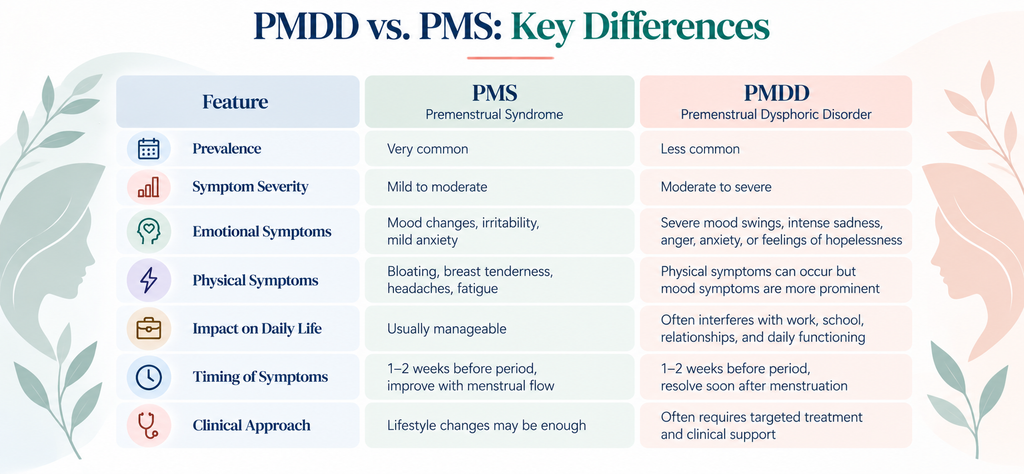
Severity and the type of symptoms. PMS covers the physical and mood changes many people notice before a period. PMDD is a recognized depressive disorder where the mood symptoms are severe enough to interfere with work, relationships, and daily functioning. The PMDD vs PMS question comes down to how disabling it is.
The numbers show the gap. The Office on Women’s Health [1] reports that over 90 percent of women notice some premenstrual symptoms, and as many as three in four have PMS at some point, while fewer than 5 percent of women of childbearing age have PMDD. It also notes that PMS is most common in women in their 30s.
That difference matters because clinicians approach the two differently. Most people experience PMS, but PMDD affects fewer than one in twenty and requires a different level of assessment, with specific guidance that general premenstrual advice does not include.
How Do Clinicians Assess the Symptom Pattern?
By tracking it forward, not backward. A clinician asks what you have noticed over the past year, then usually asks you to record symptoms daily across two cycles before confirming anything. Timing is the diagnostic feature, so they look for a pattern that repeats and then clears.
The American College of Obstetricians and Gynecologists [2] guideline on premenstrual disorders describes diagnosis as a retrospective account of the previous year combined with two months of prospective recording, and it points to validated tools such as the Daily Record of Severity of Problems. Charting forward reduces recall bias, which is the main weakness of trying to remember last month.
The criteria themselves are specific. ACOG sets out the DSM-5 requirement for at least five symptoms in most cycles of the preceding year, including at least one of four core mood symptoms, with symptoms minimal or absent in the week after a period and not explained by another condition. Reading that list and recognizing yourself in it is not the same as meeting it, which is what the charting is for.
What PMDD Medication Options Might You Discuss With a Prescriber?
An SSRI antidepressant is the main PMDD medication option, and three of them carry a specific approval for it. Combined hormonal contraception is an option for some people, though more for physical symptoms than mood ones. Supplements appear in the guidance as possible additions rather than as treatments in themselves.
ACOG [2] strongly recommends SSRIs for affective premenstrual symptoms, supported by moderate-quality evidence, and names sertraline, paroxetine, and fluoxetine as the three approved for PMDD. Several other recommendations are also strong but rest on lower-quality evidence, which is worth noting when the options are presented as equivalent.
The options break down roughly as follows.
SSRI Antidepressants
ACOG recommends these first for mood symptoms, and the evidence rating is the highest the guideline assigns to any option it reviewed.
Combined Hormonal Contraception
The guidance recommends this for premenstrual symptoms generally but not for mood symptoms specifically, and only one formulation carries an approval for PMDD in people also wanting contraception.
Supplements and Herbal Options
Calcium appears as a conditional suggestion with low-quality evidence, while the guidance makes no recommendation on vitex agnus castus because the studies are too inconsistent.
Routine exercise also appears as a conditional suggestion, with the type left to your own preference. Beyond that, which option fits depends on your symptoms, whether you also want contraception, what you have tried before, and what you are willing to take. That conversation belongs with a prescriber who can weigh them together.
When in the Cycle Is PMDD Medication Taken?
Either every day or only in the second half of the cycle, depending on what you and your prescriber decide. This is one of the few places where PMDD treatment differs from treating depression, because the symptoms arrive on a schedule and the medication can be timed to meet them.
The FDA prescribing information [3] for sertraline describes both approaches. Continuous dosing means taking it every day throughout the cycle. Intermittent or luteal phase dosing means starting around 14 days before a period is expected and continuing until it begins, then repeating that with each new cycle.
ACOG [2] notes that the limited evidence available suggests the two work comparably and that intermittent dosing may reduce side effects and discontinuation symptoms. It also says longer head-to-head studies are still needed, so this is a genuine choice to discuss rather than a settled answer.
Can Therapy for PMDD Help?
Yes, and the guidance treats it as a first-line option rather than a fallback. Cognitive behavioral therapy for PMDD works on how you anticipate and respond to the premenstrual weeks, and it is recommended for the mood symptoms specifically rather than for the physical premenstrual symptoms that often come with them.
ACOG’s recommendation for cognitive behavioral therapy [2] is strong, though it rests on low- to moderate-quality evidence, and the guideline is direct about the practical obstacles. Cost, time, and access to a therapist are listed as real barriers rather than minor inconveniences, which is worth knowing before you plan around it.
Therapy and medication are not an either-or decision. Psychotherapy and medication management are commonly arranged together, and starting with one does not rule out adding the other if the first is not enough on its own.
How Does PMDD Care Fit Alongside an OB-GYN?
Often as shared care rather than a handoff. An OB-GYN may raise PMDD first, since the symptoms are tied to the cycle, and may manage hormonal options. A psychiatric prescriber is more often involved when the mood symptoms are the main problem or when another condition may be contributing to them.
ACOG [2] says referral to a mental health professional should be considered when the diagnosis is unclear or an underlying mood disorder is suspected. That is a notable thing for an obstetrics and gynecology guideline to say, and it reflects how often premenstrual mood symptoms sit alongside depression or anxiety rather than standing alone.
Which is why the full picture matters more than the cycle alone. Premenstrual timing can mask or sit on top of anxiety, depression or ADHD, all of which can look different in women, and sorting out which is which changes what PMDD treatment makes sense.
When Should You Seek Prompt Help?
If the premenstrual weeks bring thoughts of harming yourself, that needs attention straight away rather than at the next cycle. The same applies if symptoms are escalating, you cannot keep yourself safe, or the pattern has started affecting your ability to work or care for the people around you.
Help is available at any hour. The 988 Suicide and Crisis Lifeline [4] is free and confidential, and you can reach it by calling or texting 988 or by chatting online. Call 911 if you or someone else is in immediate danger, and go to the nearest emergency department if you cannot wait.
Cyclical symptoms can make this harder to judge, because knowing it will probably lift in a few days can make you want to wait it out. If the weeks before a period regularly reach that point, bring that information to an appointment rather than riding it out each month.

Bring the Pattern, Not Just the Worst Week
Maybe you have known for years that the two weeks before your period are different, but you’ve never had a name for it. Maybe a previous appointment blamed it on stress. Or you have a tracking app full of data and no clear idea who to show it to.
At MindVita, you can discuss recurring mood symptoms and the treatment options that may suit you with a psychiatric nurse practitioner. Our Board-certified advanced practice providers provide care, and we see patients at our Vienna office or via secure video, depending on where your provider is licensed. Bring whatever tracking you already have, including the months that were fine, because the contrast between them is the part that matters. You can book an appointment when you are ready. Nothing about this has to wait for the next bad week.
FAQs
Can PMDD start later in life, after years of normal periods?
It can appear or worsen at different points, and many people first seek help in their thirties or as they approach menopause, when cycles become less predictable. A change in a long-standing pattern is worth raising rather than assuming it is age. A clinician can look at what shifted and when.
Does PMDD stop after menopause?
Premenstrual symptoms are tied to the cycle, so they generally stop once periods do. That does not mean waiting is the plan, since menopause may be years away and the transition itself can be an unsettled time for mood. Treatment in the meantime is a reasonable thing to ask about.
Can I be assessed if my cycles are irregular or I am using hormonal birth control?
Yes, though it can complicate charting, since the diagnosis depends on a cycle-tied pattern. Tell whoever assesses you what contraception you use and how regular your cycles are, because both change how the record is read and sometimes what tracking method is practical for you to keep up.
Will I need to stay on medication indefinitely?
Not necessarily. Some people take it for a period and then review; others continue for longer, and the intermittent approach means some are only taking it part of each month. This should be reviewed rather than left running by default, so ask at the outset how and when it gets revisited.
What if I track my symptoms and the pattern does not fit PMDD?
That is still a useful result. A diary showing symptoms throughout the month points toward something other than a premenstrual disorder, which changes what is worth investigating rather than closing the matter. Bring the record to the appointment either way, because what it rules out is as informative as what it supports.
References
- Office on Women’s Health, U.S. Department of Health and Human Services. “Premenstrual Syndrome (PMS).” https://www.womenshealth.gov/menstrual-cycle/premenstrual-syndrome
- American College of Obstetricians and Gynecologists (ACOG). “Management of Premenstrual Disorders: Clinical Practice Guideline Number 7.” December 2023. https://www.acog.org/clinical/guidance/clinical-practice-guideline/2023/12/management-of-premenstrual-disorders
- U.S. Food and Drug Administration. “Zoloft (Sertraline Hydrochloride) Prescribing Information.” DailyMed, National Library of Medicine. https://dailymed.nlm.nih.gov/dailymed/drugInfo.cfm?setid=fda754f6-d0f3-4dce-a17a-927d64f912f7
- 988 Suicide & Crisis Lifeline. Official website. https://988lifeline.org/