

A psychiatric evaluation is a structured first appointment where a clinician works through your symptoms, your history, your medications, and your risks, then sets out what they think is going on and what the options are. You will not necessarily leave with a diagnosis or a prescription, and that is normal.
If you have read this far, the useful next step is usually the appointment itself. At MindVita, your initial evaluation is with a psychiatric nurse practitioner (PMHNP-BC), in person at our Vienna office or by telehealth anywhere in Virginia. You can book an initial evaluation and bring whatever you have already written down.
What Is a Psychiatric Evaluation?
A clinical interview with a defined scope. It is not a quiz or a scored test. The clinician builds a picture of what has been happening, how long it has gone on, what has already been tried, and what else could explain it, to recommend a direction instead of handing you a label.
The American Psychiatric Association’s practice guidelines for the psychiatric evaluation of adults [1] organize an initial evaluation into nine areas: psychiatric symptoms and treatment history, substance use, risk of suicide, risk of aggression, cultural factors, medical health, quantitative measures, involving you in decisions, and documentation.
Most of the appointments are questions, because almost everything on that list is information only you can give. The last three areas cover what the clinician does with your answers, which is why an evaluation starts treatment rather than serving as a gate you pass through.
What Happens During a Psychiatric Evaluation?
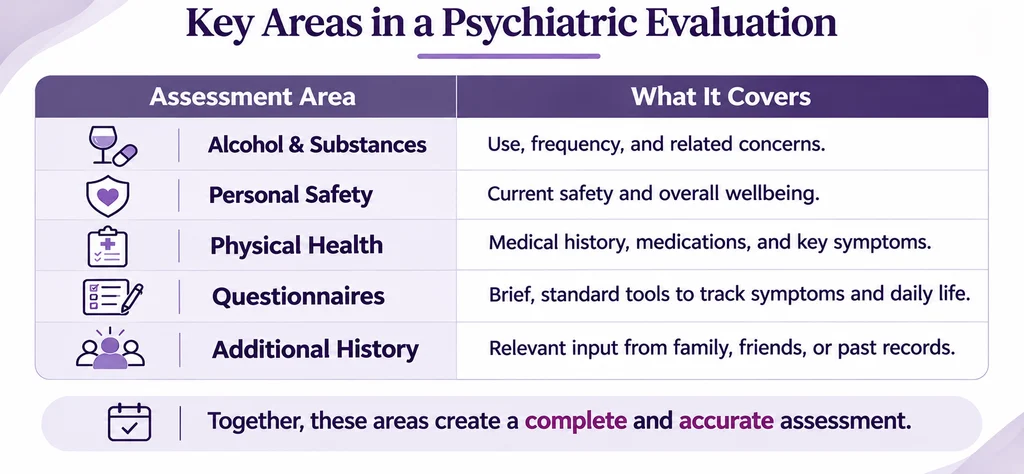
Mostly talking, in a predictable order. Expect questions about what brought you in, your mood and sleep, any past treatment and how it went, your medical history and medications, your drinking and anything else you take, and your safety. The questions get personal quickly, which is easier to handle when you know it is coming.
Alongside symptoms, the guideline [1] lists trauma history, previous diagnoses and any hospital or emergency visits, adherence and response to past treatment, psychosocial stressors such as housing, legal and work pressures, cultural factors including whether you need an interpreter, and a mental status examination.
Some of it surprises people, so it helps to know why each piece is asked.
Why They Ask About Alcohol and Other Substances
The guideline includes tobacco, alcohol, other substances, and misuse of prescribed or over-the-counter products, because all of them change what a symptom means and what is safe to prescribe.
Why They Ask About Safety
Suicide risk and risk of aggression are each their own area in the guideline. The questions are routine rather than a judgment about you, and everyone gets asked them.
Why They Ask About Your Physical Health
Allergies, current medications including supplements, neurological conditions, and a review of systems all appear, because a number of medical problems produce symptoms that look psychiatric.
Why They Use Questionnaires
The guideline recommends quantitative measures of symptoms, functioning, and quality of life, so a short form before or during the appointment is part of the method rather than paperwork.
Why They May Ask to Speak to Someone Else
Family, friends, past records, and prescription databases can corroborate history, and the guideline treats them as legitimate sources, with your confidentiality respected unless safety is at stake.
The questions narrow once a direction is clear. Our first appointment for depression covers specific ground, and our adult ADHD evaluation looks back to childhood in a way a general evaluation does not. This first appointment is the wider version that comes before either.
How Long Does It Take, and Is Telehealth as Good?
Longer than a routine medical appointment, and no guideline fixes the length, because how long it takes depends on how much history there is to cover. On the telehealth question the evidence is more settled than people expect: trials comparing video with in-person care have not found a difference in the outcomes that matter.
A systematic review and meta-analysis in JMIR Mental Health [2] pooled 20 randomized trials comparing video- and in-person outpatient psychiatric treatment in adults across PTSD, depressive disorders, and anxiety. Across 17 trials and 1,814 people, it found no difference in outcome and no difference in satisfaction or in how many people dropped out.
The authors were careful about how far that goes. They rated the certainty moderate, noted that only three trials were high quality, and did not run a formal equivalence test, so this is an absence of a measured difference rather than proof the two are identical. For most people choosing between a drive to Vienna and a video call, that is enough to decide on practicalities.
How Much Does a Psychiatric Evaluation Cost?
It depends on the practice, the length of the appointment, and whether insurance is involved. Our initial medication management assessment is $275, and the current rates are on the pricing page. Elsewhere, it varies widely, so ask any practice for the initial evaluation rate specifically, since follow-up visits are priced differently.
Before you book anywhere, check whether the quoted figure is for an evaluation or a follow-up and whether the practice bills your insurance or is self-pay. Check our pricing page instead, since prices change and articles do not.
If you plan to claim on insurance, ask what the evaluation will be coded as before the appointment, not after, because the code affects what your plan pays and is easier to confirm in advance.
How Should You Prepare for the Appointment?
Bring information, not conclusions. Your clinician needs your medication list, your dates and your history, and none of that is easy to reconstruct in the room. If the appointment is by video, a few practical things matter as well, and five minutes of setup prevents most of what usually goes wrong.
- A list of your prescription medications, including doses if you have them
- Your questions and concerns, written down before you go in
- Dates: when symptoms started, when anything changed, when you last tried treatment
- For a video visit, a private room where you can speak openly, with low background noise
- A charged device on a steady surface, camera and microphone checked, logged in five minutes early
The last two are not minor details. The telehealth guidance from the U.S. Department of Health and Human Services [3] puts that same preparation on patients, down to choosing a room with decent light so your face reads clearly on camera, and it treats arriving early as part of the care, not a courtesy.
You can also decide who the clinician may contact before you arrive. You can ask them not to contact anyone, or you can hand them a name to call; either instruction is easier to give at the start than to retrieve halfway through.
What Happens After the Evaluation?
An impression, a recommendation, and a date to come back, which is not always a diagnosis. The final part of the appointment is where the options are weighed, and you say which one you can actually live with. A prescription may come out of that conversation, or it may wait until a second visit.
The SHARE Approach from the Agency for Healthcare Research and Quality [4] sets out five steps for a treatment decision: invite the patient to take part, compare the benefits and harms of each option, take account of what matters most to them, decide together and arrange a follow-up, then revisit the decision and see how it is going.
That last step is the one people do not expect. A decision made at a first appointment is meant to be returned to, so bloodwork first, a second conversation, or a few weeks of tracking before anything gets prescribed is the process working as intended, not a delay. Most of the adjusting happens at the follow-up.
Book the Evaluation Before You Have It All Worked Out
Nobody books a psychiatric evaluation feeling ready for it. The appointment gets postponed because the symptoms don’t seem bad enough yet, because there is no tidy way to explain them, or because a diagnosis feels like something you should arrive with instead of leave with. None of that needs sorting out first.
At MindVita, that first appointment is a conversation with a board-certified psychiatric nurse practitioner, not a form to work through. We see patients in person at 8000 Towers Crescent Drive, Floor 13, Vienna, VA 22182, and by telehealth throughout Virginia. Come with your dates and a list of what you take, and the clinician will take it from there. Book an initial evaluation with the questions still open.
FAQs
Do I need a referral to book a psychiatric evaluation?
Usually not. Most outpatient practices let you book directly, and you can check that when you book. Some insurance plans require a referral for coverage even when the practice does not, so if you are claiming, check that with your plan rather than the practice, since the requirement sits on their side.
What if I freeze and cannot answer the questions?
That happens often enough that clinicians expect it. You can say you do not know, or that you would rather come back to something. Written notes help here more than anything, because handing over a page is easier than finding the words when you are already overwhelmed in an unfamiliar room.
Does a psychiatric evaluation go on a record my employer can see?
Your clinical record is protected health information, and your employer does not get access to it by asking. What an employer can receive is limited paperwork you authorize, such as a leave certification, and that is a separate document from your evaluation notes. Ask what a release covers before signing any of them.
Can I bring someone with me?
Usually yes, and it can help if your memory of the timeline is incomplete. Say at the start who is with you and what you want them to hear, because some of the questions are ones people answer differently with a partner or parent in the room. You can also ask them to step out.
What if I disagree with the conclusion?
Say so in the appointment. Shared decision-making guidance expects your preferences to be part of the decision, not collected afterward. If you still disagree, you can ask what else was considered and why it was ruled out, and you can seek a second opinion without having to repeat the whole process.
References
- American Psychiatric Association. “Practice Guidelines for the Psychiatric Evaluation of Adults, Third Edition.” 2016. https://psychiatryonline.org/doi/10.1176/appi.books.9780890426760.pe01
- Shaker AA, Austin SF, Storebø OJ, et al. “Psychiatric Treatment Conducted via Telemedicine Versus In-Person Modality in Posttraumatic Stress Disorder, Mood Disorders, and Anxiety Disorders: Systematic Review and Meta-Analysis.” JMIR Mental Health. 2023. https://mental.jmir.org/2023/1/e44790
- U.S. Department of Health and Human Services. “5 Tips to Get Health Care From Anywhere.” Telehealth.HHS.gov. https://telehealth.hhs.gov/documents/5_tips_to_get_health_care_from_anywhere_05-17-2023.pdf
- Agency for Healthcare Research and Quality (AHRQ). “The SHARE Approach: Essential Steps of Shared Decision Making.” U.S. Department of Health and Human Services. https://www.ahrq.gov/health-literacy/professional-training/shared-decision/tools/share-poster.html