

ADHD burnout can be difficult to recognize, while signs your antidepressant isn’t working can be equally challenging to assess on your own. Little change after a full trial, improvement that stalled partway, symptoms returning after months of feeling better, or side effects that outweigh the benefit are all reasons to arrange a medication review rather than make a change yourself.
Keep taking what you have been prescribed while you arrange that conversation. At MindVita, a psychiatric provider can review what you are taking, how long you have been on it, and what has and has not changed since you started, before discussing what to do next. You can book a medication review without deciding anything in advance.
How Long Do Antidepressants Take to Work?
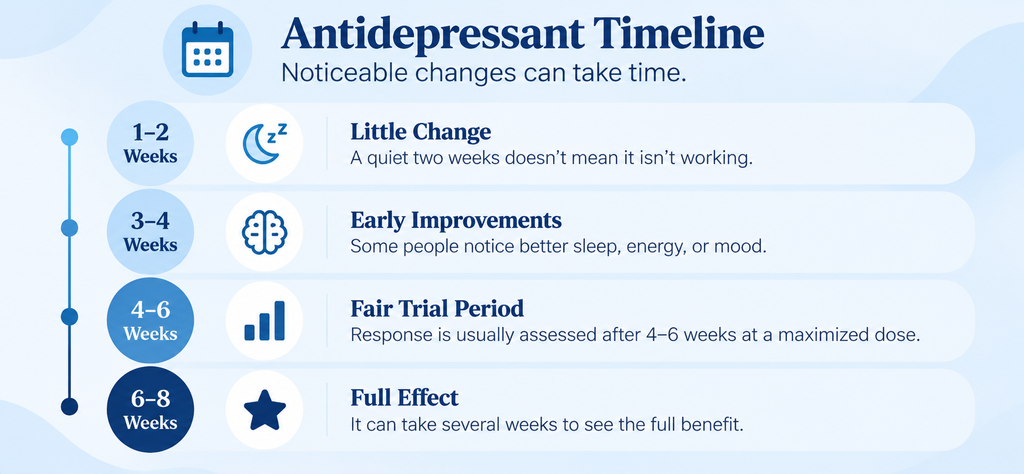
Longer than most people expect, and rarely judged fairly before several weeks have passed. A quiet two weeks means little on its own. What counts as a fair trial depends as much on the dose you have actually reached as on the number of weeks, which is why a prescriber asks about both before concluding anything.
The VA/DoD Clinical Practice Guideline for the Management of Major Depressive Disorder [1] treats partial or no response as a question to take up after at least four to six weeks on a medication at a maximized dose, which is why a prescriber will usually ask about the dose and not only the number of weeks. It also suggests using a standard depression severity measure at the start of treatment and at regular intervals afterward.
That second point matters more than it sounds. Measuring symptoms the same way over time makes a stalled response easier to see than trying to recall in the appointment how February compared with December, and it gives you and your prescriber the same picture to work from.
Signs Your Antidepressant Isn’t Working
No single experience confirms this, and none of the patterns below amounts to a diagnosis on its own. Each is a reason to arrange a review rather than wait another month, particularly when it has continued well past the point where you expected to notice some change in how you feel day to day.
A study funded by the National Institute of Mental Health [2], known as STAR*D, found that about one third of participants reached remission on the first medication they were given, with roughly another 10 to 15 percent improving without reaching remission. The study then examined what helped those who did not.
The patterns below are among the most common reasons people arrange a review.
Nothing Has Shifted After a Full Trial
Several weeks at a steady dose with no change in sleep, energy, appetite, or mood is worth raising. Your prescriber can judge whether the trial has genuinely been long enough.
Improvement Stalled Partway
You felt better for a while, then plateaued well short of feeling like yourself. A partial response is common and one of the clearest reasons a prescriber revisits the plan.
Symptoms Came Back After Months of Feeling Better
Many people searching for what to do when antidepressants stop working are describing this. When symptoms return on a medication that previously helped, it’s a recognized pattern worth reviewing promptly.
Side Effects Outweigh the Benefit
A medication that improves your mood but leaves you unable to sleep or function at work is not meeting the goal of treatment. This is worth raising plainly.
Daily Life Has Not Followed Your Mood
Questionnaire scores can improve while work, relationships, and motivation remain affected. How you are functioning day to day matters as much as how you rate your mood.
Specific details help at the appointment. When each change started, what the dose has been, which weeks were more difficult, and what you have already tried will shape the conversation more usefully than a general sense that the antidepressant is not working.
Possible Reasons Symptoms Remain
An antidepressant not working can have several explanations, and not all of them are about the drug itself. Time and dose are the usual first checks at any review. After that, a prescriber generally looks at whether something else is contributing before concluding the medication needs changing.
- Doses missed often enough to affect the medication’s level
- Sleep disorders, chronic pain, or other untreated medical conditions
- Alcohol or other substances
- Interactions with other prescriptions or supplements
- Ongoing stress, grief, or circumstances that medication alone will not resolve
- A diagnosis that may need revisiting as more history emerges
Some of these checks are standard at any review. The VA/DoD guideline directs clinicians to rule out depression secondary to other causes, naming hypothyroidism and vitamin B-12 deficiency among them, and lists comorbidities such as substance use and other psychiatric conditions among the factors shaping which treatment is chosen. It also states that it does not cover bipolar I or bipolar II, which has a separate guideline of its own, so if you have ever had stretches of unusually high energy, racing thoughts, or very little need for sleep, mention them, because that history can change which medications are appropriate.
How long is long enough also varies by medication, which is worth checking before you conclude that yours has failed. Pristiq usually provides some relief within the first week and full effect by around eight, while Zoloft is described as settling symptoms in two to three weeks, with maximum benefit closer to three months.
Options a Prescriber May Consider
There is more than one route forward, and no single next step that applies to everyone. Which one fits depends on your history, how long you have been treated, what has partly helped, and what you can tolerate. The usual options are fewer than people expect and more flexible than they sound.
- Adjusting the dose of what you are already taking
- Switching to a different antidepressant
- Adding a second medication alongside the first
- Starting therapy, or changing the therapy you already do
- Revisiting the diagnosis itself
The VA/DoD guideline sets out four of these for partial or no response to an adequate trial of the first medication: switching to a different antidepressant, switching to psychotherapy, adding psychotherapy, or adding a second-generation antipsychotic. It lists them without ranking them.
The STAR*D findings reported by the National Institute of Mental Health [2] give some sense of what those steps offered. Among participants whose first medication did not work, about 25 percent became symptom-free after switching and about one third after adding a second medication, though the researchers noted the odds narrowed with each additional step. A first medication that doesn’t work is a starting point, not a final answer, and medication management is largely the process of reviewing and adjusting over time.
Why Not to Stop or Change Your Medication on Your Own
Stopping suddenly can create a second problem alongside the first one. Lowering a dose, skipping days, or stopping altogether without speaking to your prescriber may bring on withdrawal effects, increase the risk of symptoms returning, and make it considerably harder to determine what was actually happening in the first place.
The FDA prescribing information [3] for escitalopram, one widely used antidepressant, reports discontinuation reactions including dysphoric mood, irritability, agitation, dizziness, and insomnia, particularly when a medication is stopped abruptly, and states that a gradual reduction in dose rather than abrupt cessation is recommended whenever possible. It adds that if intolerable symptoms follow a dose decrease, resuming the previously prescribed dose may be considered, with the reduction then continued at a more gradual rate. That kind of adjustment is straightforward for a prescriber to manage and difficult to judge on your own.
There is a practical reason beyond comfort. Withdrawal effects and returning depression can feel similar, and distinguishing between them is much easier when a prescriber knows exactly what changed and when. If cost, side effects, or uncertainty are making you consider stopping, those are all appropriate things to raise at a review.
When to Book a Review or Seek Urgent Care
Book a review when a pattern above has persisted, when side effects are affecting your daily life, or when you have started wondering whether to stop. You do not need to wait for a scheduled follow-up, and you do not need to have made up your mind about what should change.
Some situations need faster attention. The National Institute of Mental Health [4] advises that people taking antidepressants be watched closely, especially during the first few weeks of treatment and when a dose is changed, since children, teenagers, and young adults under 25 may experience an increase in suicidal thoughts or behavior during those periods.
If you are having thoughts of suicide or self-harm, the 988 Suicide and Crisis Lifeline [5] offers free, confidential support 24 hours a day, seven days a week by call, text, or online chat. Call 911 if you or someone else is in immediate danger. A scheduled appointment isn’t the right option for an emergency.

Book a Medication Review With MindVita
You have given it another month more than once. You raised it and were told to continue. The side effects arrived, but the improvement stalled, and you are no longer sure whether the problem is the medication, the dose, or you. Nobody has given you a plan for what happens next.
At MindVita, we start by reviewing what you have already taken: the dose, how long you took it, and what worked before it stopped. If the problem turns out to be the prescriber rather than the prescription, switching psychiatric providers can happen without a gap in your medication as long as the records and refill dates line up first. Book a medication review and bring the dates, because nobody can reconstruct them later.
FAQs
Should I keep taking my medication while I wait for the appointment?
Yes, unless your prescriber has advised otherwise. Stopping in the days before a review removes information your provider needs and may add withdrawal effects to the symptoms you already have. If something urgent develops while you wait, contact the practice rather than adjusting the dose yourself or waiting for the scheduled appointment.
How do I tell the difference between the medication not working and a hard few weeks?
This can be difficult to judge on your own, which is why the overall timeline matters more than any single week. How long it has lasted, whether it followed a specific event, and whether sleep and appetite changed alongside your mood all help a prescriber distinguish between them. Recording dates as they occur is more reliable than recalling them later.
Does needing to switch mean I have treatment-resistant depression?
Not by itself. That term has a specific clinical meaning involving adequate trials of more than one medication, and a single medication that did not suit you does not meet it. Your prescriber can explain where your history sits and what that does or does not change about your options.
Will my prescriber think I am being difficult if I say it is not working?
A good prescriber will want to know, since treatment that isn’t helping isn’t worth continuing by default. Being specific about what has and has not changed is more useful than softening the message. If you raise concerns repeatedly and nothing changes, that is useful information about the fit with that provider.
Can therapy help if medication alone has not?
It may. Therapy and medication work differently, and some people respond better to both than to either one alone. Whether that applies to you depends on your symptoms, history, and preferences, which is worth raising at the same review rather than as a separate decision.
References
- U.S. Department of Veterans Affairs and U.S. Department of Defense. “VA/DoD Clinical Practice Guideline for the Management of Major Depressive Disorder.” Version 4.0, 2022. https://healthquality.va.gov/HEALTHQUALITY/guidelines/MH/mdd/VADoDMDDCPGFinal508.pdf
- National Institute of Mental Health (NIMH). “Sequenced Treatment Alternatives to Relieve Depression (STAR*D): All Medication Levels.” https://www.nimh.nih.gov/funding/clinical-research/practical/stard/allmedicationlevels
- U.S. Food and Drug Administration. “Lexapro (escitalopram) Prescribing Information.” https://www.accessdata.fda.gov/drugsatfda_docs/label/2024/021365s041lbl.pdf
- National Institute of Mental Health (NIMH). “Mental Health Medications.” https://www.nimh.nih.gov/health/topics/mental-health-medications
- 988 Suicide & Crisis Lifeline. Official website. https://988lifeline.org/