

An intensive outpatient program (IOP) care is a structured mental health treatment approach that provides several hours of care each week while allowing you to continue living at home. It sits between weekly therapy appointments and the more intensive options, and it is generally considered when regular outpatient care is not providing enough support.
MindVita does not offer intensive outpatient programs. This article explains what IOP involves and how it compares with other levels of care, so you can decide which one fits your situation. If weekly outpatient care is what you are looking for, MindVita provides medication management and psychotherapy, and you can book an appointment directly.
What Is an Intensive Outpatient Program?
An IOP provides several structured treatment sessions each week, usually combining group therapy with individual sessions and, where appropriate, medication management. You attend on a set schedule and return home afterward, allowing many people to keep working, studying, or caring for family while receiving a higher level of support.
Medicare [1] describes intensive outpatient programs as a level of care for mental health conditions that sits between weekly therapy and inpatient or partial hospitalization care. Its coverage applies when a care plan states that a person requires at least nine hours of therapeutic services each week, and services may be provided in hospitals, community mental health centers, Federally Qualified Health Centers, and similar settings.
IOP mental health programs differ in how they are organized. Each program sets its schedule, session length, group size, and treatment focus, so two IOPs in the same area may run quite differently. Asking a program directly about its structure is usually more reliable than assuming a standard format.
IOP vs Partial Hospitalization vs Standard Outpatient Care
The three levels differ mainly in how many treatment hours they provide each week and how much structure they offer. Standard outpatient care generally means scheduled appointments. An IOP adds a structured weekly schedule. Partial hospitalization provides the most time and supervision of the three while still allowing you to return home.
Medicare [2] describes partial hospitalization as a structured program of outpatient psychiatric services offered as an alternative to inpatient care, with sessions that usually run between four and eight hours each day. Coverage applies when a care plan shows a need for at least 20 hours of therapeutic services per week, and a provider must certify that the person would otherwise require inpatient treatment.
| Standard outpatient | Intensive outpatient (IOP) | Partial hospitalization (PHP) | |
| Typical time commitment | Scheduled appointments, often weekly or monthly | At least 9 hours of therapeutic services per week under Medicare | At least 20 hours per week, usually 4 to 8 hours per day, under Medicare |
| Where you sleep | At home | At home | At home |
| Common settings | Private practices, clinics, telehealth | Hospitals, community mental health centers, and similar programs | Hospital outpatient departments and community mental health centers |
| Generally considered when | Symptoms can be managed with regular appointments | More structure is needed than weekly appointments provide | A provider certifies that inpatient care would otherwise be required |
The hour thresholds above are Medicare’s coverage criteria, not universal definitions. Other insurers set their own requirements, and individual programs may structure their schedules differently, so confirm the details with the program and your plan before enrolling.
How Clinicians Decide Which Level of Care Fits
The decision rests on clinical assessment rather than preference alone. A provider considers symptom severity, safety, how much daily functioning has been affected, how you have responded to treatment so far, and what support is available at home. The goal is the least restrictive level of care that safely meets your needs.
Medicare’s requirements reflect this reasoning. As noted above, partial hospitalization coverage depends on a provider certifying that inpatient treatment would otherwise be needed, which shows that level of care decisions are tied to clinical judgment and documented need rather than to a patient’s request on its own.
The factors below are the ones most often weighed during that assessment.
Safety
Whether you are at risk of harming yourself or others is assessed first, because it can rule out some levels of care and make others necessary regardless of other factors.
How Much Daily Life Is Affected
A provider considers whether you can manage work, study, relationships, and basic self-care. Difficulty in several of these areas may point to the need for more structured support.
Response to Current Treatment
If symptoms have continued or worsened despite regular appointments and appropriate medication changes, that history suggests the current level of care may not be providing enough support.
Support at Home
Whether you have stable housing, people around you, and a reasonably predictable daily routine affects how much structure a treatment program needs to provide on its own.
Medical and Medication Needs
Complex medication regimens, co-occurring medical conditions, or recent changes to treatment may require closer and more frequent monitoring than a weekly appointment schedule can realistically provide.
These factors are weighed together rather than individually, and the conclusion can change over time. Someone who begins in an IOP may step down to weekly appointments as symptoms improve, and someone in weekly care may be referred to a more structured program if their symptoms worsen.
After IOP: What Outpatient Follow-Up Usually Involves
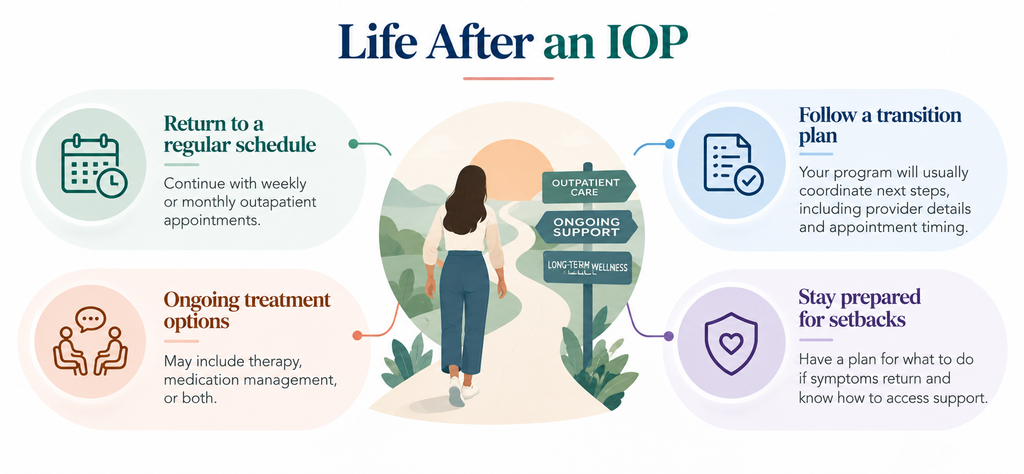
Most people continue some form of treatment after completing an IOP rather than stopping altogether. Follow-up commonly returns to a weekly or monthly outpatient schedule, which may include therapy, medication management, or both, with appointment frequency based on symptom stability and the treatment team’s recommendations.
The program itself usually coordinates this transition. Discharge planning typically covers which provider you will see next, when the first appointment is, which medications continue, and what to do if symptoms return. Asking about these details before you finish the program tends to prevent gaps in care.
If you are arranging follow-up yourself, scheduling the first outpatient appointment before your last IOP session is generally the safer approach. Waiting until after discharge can mean several weeks without support, which is precisely the period when continuity matters most.
Insurance and Finding a Suitable Program
Coverage for IOP varies by plan, so the practical first step is usually to ask your insurer which programs are in network and what documentation they require. Many plans require prior authorization and periodic reviews to continue coverage, and the program’s admissions team can often help with the paperwork.
SAMHSA [3] directs people seeking treatment to FindTreatment.gov and its National Helpline at 1-800-662-HELP (4357), both of which can help you find programs in your area. For Medicare specifically, the coverage page cited earlier notes that after the Part B deductible, you generally pay 20 percent of the Medicare-approved amount for these services.
Questions worth asking any program before enrolling include:
- How many hours per week does the program run, and on which days?
- Is there an evening or virtual option if I am working?
- Does the program include medication management, or will I need a separate prescriber?
- How long do people typically stay, and how is that decided?
- What does discharge planning involve?
- Is the program in network with my insurance, and what will I pay?
Emergencies: When IOP Is Not the Right Step
An intensive outpatient program is scheduled treatment, not emergency care, and it is not the right route during a crisis. If you are having thoughts of suicide or self-harm, or you are concerned about someone’s immediate safety, emergency resources are the appropriate option rather than waiting for a program place or an appointment.
The 988 Suicide and Crisis Lifeline [4] provides free, confidential support 24 hours a day, seven days a week. You can call or text 988, or chat online. Call 911 or go to your nearest emergency department if you or someone else is in immediate danger.
A crisis usually builds rather than arriving all at once. Prolonged sleep problems, grief, relationship conflict, and money or work pressure are among the common causes of a mental health crisis, and the early warning signs are often practical ones: withdrawing from people, struggling with tasks that are normally routine, or making decisions that feel out of character.
If Weekly Outpatient Care Is the Right Fit
You may have reached this article after a hospital discharge, after a therapist suggested more structure, or while trying to work out whether weekly appointments are still enough. Those situations call for different answers, and the level of care that suits one may not suit another.
MindVita provides outpatient care and does not offer intensive outpatient programs. If you need an IOP or a higher level of care, the resources described above are the right place to start. If weekly outpatient care fits your situation, medication management and psychotherapy are both available, and you can book an appointment when you are ready.

FAQs
Can I keep working or studying while attending an IOP?
Many people do, which is why this level of care exists. Programs often run in the morning or evening to accommodate work and study schedules, though the time commitment is still substantial. Ask about available session times before enrolling, and consider whether any adjustment at work or school would help.
How many weeks does an intensive outpatient program usually last?
Length varies by program and by how a person responds, so there is no standard duration. Programs generally review progress at intervals and adjust accordingly, and insurers often reassess coverage periodically as well. The admissions team can usually give you a realistic range for their particular program when you ask during the assessment.
Do I need a referral to join an intensive outpatient program?
It depends on the program and on your insurance. Some programs accept direct inquiries and complete their own assessment, while others require a referral from a provider or prior authorization from your insurer. Calling the program first is usually the quickest way to find out what they need from you.
Can I keep seeing my own therapist or prescriber during an IOP?
Sometimes, though it varies by program. Some programs provide all treatment internally for the duration, while others will coordinate with providers you already see. Raise this at the assessment stage, since continuity with a provider who knows your history can make the transition back to outpatient care more straightforward.
What happens if an intensive outpatient program is not enough?
Your treatment team reassesses and may recommend a more structured option, such as partial hospitalization or inpatient care, depending on what is driving the difficulty. This is a normal part of treatment, not a failure, and the goal is to match the level of support to what your symptoms currently require.
References
- Medicare.gov. “Mental Health Care (Intensive Outpatient Program Services).” https://www.medicare.gov/coverage/mental-health-care-intensive-outpatient-program-services
- Medicare.gov. “Mental Health Care (Partial Hospitalization).” https://www.medicare.gov/coverage/mental-health-care-partial-hospitalization
- Substance Abuse and Mental Health Services Administration (SAMHSA). “Find Help.” https://www.samhsa.gov/find-help
- 988 Suicide & Crisis Lifeline. Official website. https://988lifeline.org/