

Parents usually start looking for an adolescent psychiatrist when something has gone on too long to call a phase. A psychiatric evaluation sorts out whether what you are seeing is a treatable condition, what is driving it, and what to do next. It does not commit your teen to medication.
The credential that does this work is not always the title people search for. At MindVita the evaluation is run by a psychiatric nurse practitioner, credentialed PMHNP-BC, and we see patients from age five upward, in Vienna or by video across the state. Book a teen evaluation and bring the school emails.
What Are the Signs Your Teen May Need a Psychiatric Evaluation?
Duration and interference, more than intensity. A bad two weeks is not the signal; a change that has held for months and is costing your teen school, sleep or friendships is the signal. Any talk of self-harm moves it from something to watch to something to act on the same day.
The American Academy of Child and Adolescent Psychiatry [1] keeps a list of the signs that matter at this age, and it is longer than most families expect. The academy’s position is that an evaluation by a child and adolescent psychiatrist is appropriate for any young person with emotional or behavioral problems. It tells you to consider one when a problem has held for a long stretch, or when other adults around your teen have started raising concerns of their own. What it asks you to watch for is specific:
- A marked decline in school performance, or trouble coping with ordinary daily activities
- Major changes in sleeping or eating habits
- Severe mood swings, or a sustained low mood that includes thoughts of death
- Repeated use of alcohol or drugs
- Threats of self-harm or harm to others, self-injury, or repeated threats to run away
- Strange thoughts, beliefs, feelings or unusual behaviors
Some of these need attention today rather than at the next free appointment. If your teen has talked about suicide, said anything about wanting to be dead, or hurt themselves, call the 988 Suicide and Crisis Lifeline [2]. It takes calls, texts and chats at any hour, and it will talk to a worried parent as readily as to a teenager. If your teen is in immediate danger, call 911.
What Does an Adolescent Evaluation Involve?
A few hours of talking, usually across more than one visit, with you in the room for part of it. The clinician interviews your teen and you separately and together, gathers history from school and medical records with your permission, then explains in plain terms what they have concluded from it.
AACAP’s guidance on comprehensive psychiatric evaluation [3] sets out the ground covered: current symptoms, your teen’s physical and psychiatric history including current medications, family health and psychiatric history, development, school and friendships, and family relationships. Lab tests or psychological, educational and speech assessments get added when they are needed.
A few parts of it surprise parents.
You Will Be Interviewed Too
Parents and guardians are interviewed as part of the evaluation, not just consulted afterward, because much of the history only exists in your memory of it.
Your Teen Gets Time Alone With the Clinician
Adolescents are seen on their own for part of the appointment, which is how clinicians get answers about substance use and self-harm that are not performed for a parent.
School and Other Sources May Be Contacted
With your permission the clinician may approach the family doctor, school staff or other relatives, because a teenager behaves differently in each of those settings.
It Takes More Than One Appointment
Two or three sittings is a common pattern, so the clinician’s formulation comes once the whole process is finished, not at the close of your first hour.
You Should Leave With an Explanation
The academy expects the family to get the problem explained in terms both parent and teen can follow, time for questions, and a specific treatment plan if one is needed.
One line in that guidance is aimed squarely at parents. It describes the clinician’s job as being a partner rather than judging or blaming the family. Many parents arrive braced for the opposite, and that expectation is part of what delays the appointment by months.
Medication for Teens: What Should Parents Know?
That it is one option rather than the whole plan, and that it comes with a boxed warning you should read before deciding anything. Most antidepressants are not approved for children at all. The ones that are carry a specific monitoring requirement that falls partly on you as the parent.
The FDA prescribing information for fluoxetine [4] is the clearest example, since it is approved for major depressive disorder from age eight and for obsessive compulsive disorder from age seven. Its boxed warning reports a higher rate of suicidal thinking and behavior among children, adolescents and young adults in short-term trials, and tells anyone weighing one of these drugs for a young person to set that risk against the clinical need.
The warning then names you directly. It says families and caregivers should be advised of the need for close observation and communication with the prescriber, which in practice makes you the monitoring system for the first few weeks. The same warning records no increased risk in adults past twenty-four, which is why this conversation belongs to adolescence specifically.
How Do Therapy and School Support Fit In?
Therapy usually comes first for teenagers, and school support runs in parallel rather than waiting for a diagnosis. A mental health condition can qualify your teen for accommodations under Section 504, and the school does not need a doctor’s note from you to start looking at it in the first place.
The US Department of Education’s guidance on disability discrimination [5] is specific here. It gives anxiety disorders and ADHD as conditions that in many cases substantially limit a major life activity. It also states that no medical diagnosis is needed for a Section 504 evaluation, and that a school cannot make parents hand over medical documentation before it will agree to evaluate. Where a medical assessment is needed, the school provides it at no cost to you.
Good grades do not settle the question either, and the same guidance says a school cannot delay an evaluation because your teen is already receiving classroom interventions. On the clinical side, therapy for children and teens is usually the first thing arranged, and it runs alongside whatever the school puts in place instead of replacing it.
Should You See Someone in Vienna or by Telehealth?
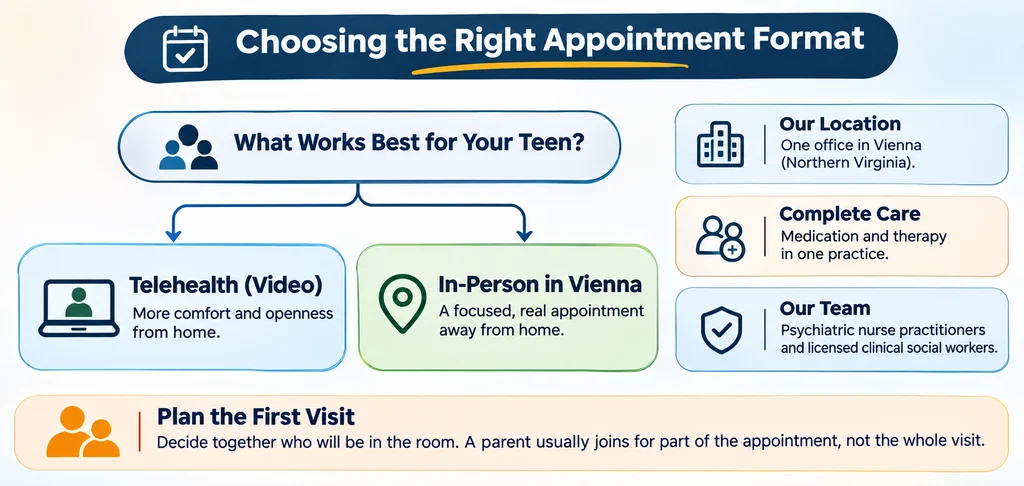
Either works for most of this, and the choice usually comes down to your teen rather than the clinical need. Some adolescents talk more freely on video from their own room. Others need the appointment to feel like a real appointment, away from the house and the people in it.
We run a single office in Vienna, which is the practical answer for families searching for a teen psychiatrist or an adolescent psychiatrist near them in Northern Virginia. Everywhere else in the state is video. Our prescribers are psychiatric nurse practitioners and our therapists are licensed clinical social workers, so medication and therapy can be arranged through one practice.
One thing to settle before the first appointment is who sits in the room. A parent usually sits in for some of the appointment but not the whole of it, and telling your teen that in advance tends to lower the resistance considerably.
You Are Not Overreacting by Booking
The arguments about whether this is serious enough have probably been going on at home for a while. One of you thinks it is adolescence. The other has been reading at midnight. Meanwhile the school has emailed twice, and nobody has made the call because making it feels like a verdict.
At MindVita, booking an evaluation is not a verdict on your parenting or a decision about medication. The prescriber works from what you have both been seeing, spends time with your teen alone, then tells you plainly whether this needs treating. Our address is 8000 Towers Crescent Drive, Floor 13, Vienna, VA 22182. Families further out are seen on video. Book a teen evaluation and let someone else carry the question for a while.
FAQs
Can my teen refuse to go?
Often they do at first, and it is worth going anyway. Framing it as one appointment to get information, with no commitment attached, works better than framing it as treatment. Clinicians who see adolescents are used to a reluctant first visit and do not treat it as a bad sign.
Will I be told what my teen says in private?
Some of it, and not all of it. Clinicians working with adolescents generally share what affects safety and treatment decisions while protecting the rest, because a teenager who expects a full transcript stops talking. Ask at the start how the clinician handles it so everyone knows the rules in advance.
Does a mental health diagnosis follow my teen to college?
Not in the way parents fear. Clinical records are protected health information and college applications do not request them. Accommodations your teen uses at school can carry over to college if they choose to request them there, and that is their decision to make when they get there, not yours now.
What if my teen already sees a school counselor?
That is useful and it is not the same thing. School counselors handle a lot and are not set up to diagnose or prescribe, and caseloads often do not allow weekly sessions. Tell the evaluating clinician who else is involved in the care, because it saves repeating the same ground twice.
How do I raise this with my teen without a fight?
Lead with what you have noticed rather than what you suspect. Naming the sleep, the grades or the withdrawal invites less argument than naming a condition. Giving them some say in the timing and in who comes along tends to matter more to a teenager than the appointment itself does.
References
- American Academy of Child and Adolescent Psychiatry. “When to Seek Help for Your Child.” Facts for Families No. 24. https://www.aacap.org/AACAP/Families_and_Youth/Facts_for_Families/FFF-Guide/When-To-Seek-Help-For-Your-Child-024.aspx
- 988 Suicide & Crisis Lifeline. Official website. https://988lifeline.org/
- American Academy of Child and Adolescent Psychiatry. “Comprehensive Psychiatric Evaluation.” Facts for Families No. 52. https://www.aacap.org/AACAP/Families_and_Youth/Facts_for_Families/FFF-Guide/Comprehensive-Psychiatric-Evaluation-052.aspx
- U.S. Food and Drug Administration. “Fluoxetine Prescribing Information.” DailyMed, National Library of Medicine. https://dailymed.nlm.nih.gov/dailymed/drugInfo.cfm?setid=59de2889-c3d3-4ebf-8826-13f30a3fa439
- U.S. Department of Education, Office for Civil Rights. “Frequently Asked Questions: Disability Discrimination.” https://www.ed.gov/laws-and-policy/civil-rights-laws/disability-discrimination/frequently-asked-questions-disability-discrimination