

ADHD accommodations at work are changes to how a job gets done, not exemptions from doing it. They are requested under the Americans with Disabilities Act; they depend on how your symptoms limit you and not on the diagnosis itself, and your employer has a say in which ones it provides.
A prescriber contributes the clinical half, and nothing in this article is legal advice. At MindVita, adult ADHD is assessed and treated by our psychiatric nurse practitioners, credentialed PMHNP-BC, from the Vienna office or over video statewide. Whether an accommodation letter fits your situation is a judgment your prescriber makes case by case, not something we can promise in advance. You can book an adult ADHD appointment and raise the work side at it.
Is ADHD Covered at Work?
Sometimes, and it turns on limitation rather than label. The ADA has no list of qualifying conditions, so what matters is whether your symptoms substantially limit something like concentrating, organizing, or sustaining work. Plenty of people with ADHD are covered. Plenty of others have a diagnosis and no accommodation need at all.
The National Institute of Mental Health [1] puts it directly: people whose ADHD symptoms cause impairment at work may qualify for reasonable accommodations under the ADA. The Equal Employment Opportunity Commission [2] adds the part that surprises people: a condition is assessed based on what it would do if left untreated, and it does not have to be permanent or severe to count as substantially limiting.
That untreated standard matters if you are already on medication. Being treated and doing well does not take you outside the law, because the test looks at the condition without treatment. A diagnosis on its own still proves nothing about your limits, which is why an adult ADHD evaluation documents function and not only criteria.

Common ADHD Accommodations at Work
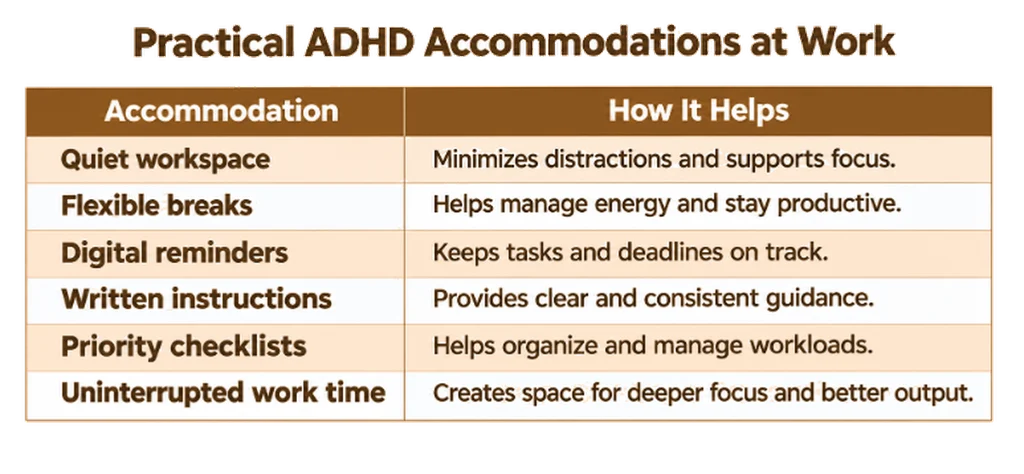
Quiet space, schedule flexibility, written instructions, and support with priorities, mostly. The useful ones are specific to the limitation they address, so a request for a quiet room reads differently from a request to be left alone. Nothing here is a standard package, and no employer is obliged to grant any particular item.
The Job Accommodation Network [3] organizes its ADHD suggestions by the limitation each one targets, and it notes that the degree of limitation varies between individuals and that not all people with ADHD need accommodations to do their jobs. Several of them recur across more than one grouping:
- A quiet workspace, noise cancelling headsets or white noise, and uninterrupted work time, for focus
- A flexible or modified break schedule, and working from home where the office cannot be made workable
- Written instructions, to-do lists and help with prioritizing, for time management
- Reminders, calendars, timers and apps, plus additional training time, for memory
- Job restructuring that keeps your essential duties and shifts the marginal ones, for organizing and planning
Reading that list, the honest reaction is that some of it is just good management. That is the point. An accommodation is simply a change in how things are normally done, which often means asking for the version of the job that would have worked all along, with the law behind the request.
How to Ask Your Employer
Say what you need and why, in plain words, to someone who can act on it. There is no form to track down and no phrase to get right. Telling a supervisor or HR that you need a change at work because of a medical condition is enough to start the process.
The commission’s guidance on reasonable accommodation [4] confirms you can use plain English without naming the ADA or saying the words “reasonable accommodation,” that a request may come from a family member, friend, or health professional on your behalf, and that you may make one at any point during employment instead of only at hiring. The request then opens an informal, interactive process between you and your employer.
Two practical notes follow from that. Your employer may ask you to put the request in writing, which is worth doing anyway because it fixes the date. And the interactive process is a negotiation rather than a verdict, so if what you asked for is refused, the next question is what the employer would provide instead.
What Documentation May Be Needed?
A letter from your provider, usually, confirming a condition and the limits it creates. It need not name your diagnosis, it gives nobody a right to your records, and what it has to establish is narrower than most people assume when they hand over everything they already have in a folder somewhere.
Written confirmation from your health care provider is something an employer may seek, documenting that you have a mental health condition. Where you prefer not to disclose the specific diagnosis, a more general description of the condition may be enough. Your employer may also ask your provider whether a particular accommodation would meet your needs, and it has to keep what it learns confidential, including from your co-workers.
The limits on that request are the part worth knowing.
Only Enough to Establish the Need
Guidance [4] says an employer may require only the documentation needed to show an ADA disability and the need for accommodation, which is not your full medical file.
A General Description Can Be Enough
If keeping the specific diagnosis off your employer’s file matters to you, a broader account of the condition and its effects may satisfy the request instead.
Your Employer Picks Among Options That Work
When more than one accommodation would be effective, your preference gets primary consideration, and the employer makes the final choice among the options that actually work.
Essential Duties Stay
Eliminating an essential function of the job is not required, so an accommodation changes how a core duty is done rather than removing it altogether.
Cost and Disruption Are a Defense
An employer can decline an accommodation that involves significant difficulty or expense, judged against its own resources rather than a standard applied to every workplace.
None of that is a reason to volunteer more than you were asked for. If your prescriber is writing the letter, the content that earns its place is what you cannot reliably do and what would help, which is also what a proper look at how ADHD is diagnosed and managed is set up to establish.
When Treatment and Accommodations Work Together
Each covers what the other cannot. Treatment works on symptoms and accommodations work on the environment, so a plan that addresses only one leaves the other problem in place. The combination creates a practical need of its own, since appointments have to fit into an actual working week.
Effective treatment often combines elements, including medication, behavioral and cognitive behavioral therapy, coaching in executive function skills, and lifestyle changes. Altered break and work schedules specifically, scheduling work around therapy appointments where the two halves meet on a calendar.
One limit belongs in plain sight. An employer does not have to excuse poor job performance, even when the cause is a medical condition or a medication’s side effects, which is why it helps to get both halves in place early rather than after a review has already gone badly. Whether medication is part of your plan is a separate conversation from the accommodation request, and that one belongs with a prescriber.
Asking for Less Friction Is Not Asking for Less Work
The fear in this is usually specific. Not that the accommodation will be refused, but that asking marks you as someone who cannot cope, and that the mark outlasts the quiet room. So the friction gets absorbed privately instead, with evenings spent finishing what an open-plan afternoon ate, filed away as a personal failing.
At MindVita the part we can speak to is the clinical one. A psychiatric nurse practitioner works out whether ADHD explains what you are describing, treats it where it does, and documents function in terms a letter can carry. Whether a letter suits your situation is decided at the appointment rather than promised beforehand, and the legal side is an employment lawyer’s territory or the EEOC’s. We are at 8000 Towers Crescent Drive, Floor 13, Vienna, VA 22182, and we offer video appointments everywhere else in Virginia. Book an adult ADHD appointment and bring the examples from your own week.
FAQs
What if the problem is my manager rather than my workspace?
Changes in supervisory methods are a recognized accommodation, and so is more structured one-to-one communication about expectations. Raise it with HR rather than with that manager, and describe the mechanism instead of the person, since a request about how instructions reach you lands differently from a complaint about who delivers them.
Does an ADHD diagnosis from childhood still count?
The diagnosis does not expire, though your employer is asking about now rather than then. What a request turns on is current limitation, so a childhood assessment usually needs a current description of how the symptoms affect this particular job. A prescriber who is treating you now can supply that second part.
Can I be penalized for asking?
Not legally. The commission [2] states your employer cannot fire you or refuse to promote you because you asked for an accommodation or because you need one. If it happens anyway, the EEOC takes charges, and the window is 180 days from the alleged violation, or 300 days where a state or local employment discrimination law also covers your employer.
Should I tell my co-workers?
That is your call and nobody else’s. The confidentiality duty sits with your employer rather than with you, so you can say as much or as little as you like. Some people find a short word to the colleagues they work with daily removes the awkwardness around a changed schedule, and others keep it to HR.
Should I ask for everything on the list?
Pick the two or three that match your actual limits. A long list reads as a negotiating position and dilutes the specific thing you most need, while a short request tied to a concrete problem is easier for an employer to say yes to. You can raise a further item later on.
References
- National Institute of Mental Health. “ADHD in Adults: 4 Things to Know.” NIH Publication No. 24-MH-3573, 2024. https://www.nimh.nih.gov/health/publications/adhd-what-you-need-to-know
- U.S. Equal Employment Opportunity Commission. “Depression, PTSD, and Other Mental Health Conditions in the Workplace: Your Legal Rights.” https://www.eeoc.gov/publications/depression-ptsd-other-mental-health-conditions-workplace-your-legal-rights
- Job Accommodation Network. “Attention Deficit Hyperactivity Disorder (AD/HD).” U.S. Department of Labor, Office of Disability Employment Policy. https://askjan.org/disabilities/Attention-Deficit-Hyperactivity-Disorder-AD-HD.cfm
- U.S. Equal Employment Opportunity Commission. “Enforcement Guidance on Reasonable Accommodation and Undue Hardship under the ADA.” 2002; the ADA Amendments Act of 2008 later broadened the statutory definition of disability. https://www.eeoc.gov/laws/guidance/enforcement-guidance-reasonable-accommodation-and-undue-hardship-under-ada