
Perimenopause anxiety and low mood are common enough to be recognized in clinical guidelines, and they are not automatically caused by hormones. The transition does appear to be a vulnerable window for some women. It is also a life stage marked by disrupted sleep, caregiving pressure, and other factors that need to be ruled out.
If your mood has shifted and you are unsure what is driving it, we can answer that question. At MindVita, we can do a mood assessment that considers your full history rather than just your age, and we can coordinate with the clinician managing your menopause care when that helps. You can book a mood assessment to start there.
What Mood Changes Happen During Perimenopause?
Low mood, irritability, anxiety, and sleep disruption are the ones reported most. Guidelines treat early perimenopause as a period of raised risk for depressive symptoms, including in women who have never had depression before. That does not make the changes inevitable, and it does not make hormones the whole explanation.
The perimenopausal depression guideline [1] from the North American Menopause Society and the National Network of Depression Centers describes this stage as a window of vulnerability for both depressive symptoms and full depressive episodes, with risk raised even in women who have no history of major depression.
One finding complicates the usual story. The same guideline notes that most midlife women who have a depressive episode during perimenopause have had one before, so it is usually a recurrence rather than something new. First episodes do happen, but they are less common.
Is It Perimenopause Anxiety, Depression, or Something Else?
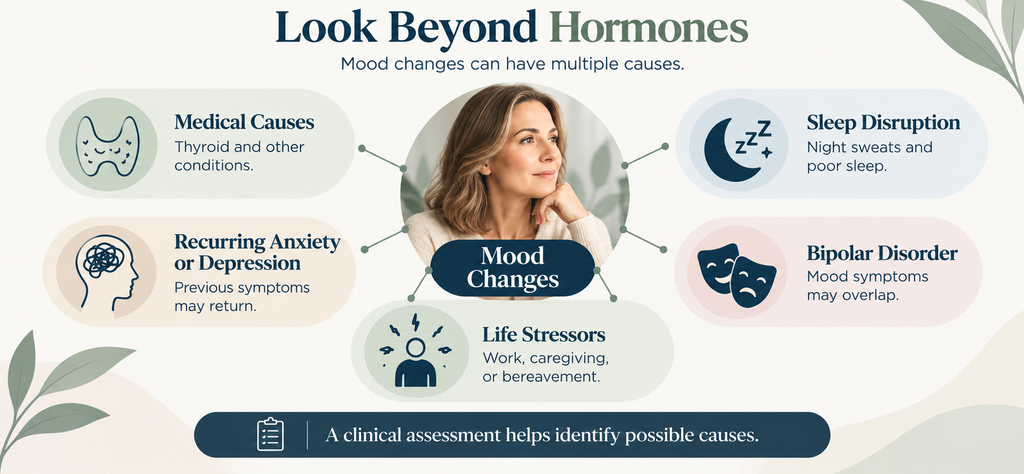
Possibly any of them, and age alone cannot sort it out. Perimenopause depression has specific features a clinician looks for, anxiety has others, and several conditions unrelated to hormones produce the same symptoms. Sorting it out means looking at your history and your timeline, not just your date of birth.
- Thyroid or other general medical causes, which blood tests can check
- Sleep disruption from night sweats, which lowers mood on its own
- A depressive or anxiety disorder recurring rather than starting now
- Bipolar disorder, which mood swings at this stage can resemble
- Caregiving, bereavement, or work and relationship changes landing at the same time
Research on menopause and anxiety has a wrinkle in it. A survey of 272 women aged 40 to 60 [2] published in Frontiers in Psychiatry found early perimenopausal women were the most bothered by both anxiety and depression, but that age accounted for the differences in anxiety, while the depression finding held after adjusting for age.
The pattern repeats across life stages. Mood symptoms in women get attributed to hormones at several points, which is partly why anxiety, depression and ADHD in women go unrecognized for years, and why a clinician investigates rather than assumes.
What Psychotherapy and Medication Options Help?
Antidepressants and psychotherapy are the front-line options, the same as for depression at any other age. Cognitive behavioral therapy is specifically supported here. The best combination depends on severity, what has worked for you before, and whether sleep and hot flashes are part of the problem.
The NAMS and NNDC guideline [1] puts proven antidepressants and psychotherapy, including CBT, as front-line treatments for a major depressive episode in perimenopause. It notes that SSRIs and SNRIs show good efficacy and tolerability at usual doses, and that a prior good response to a particular antidepressant should guide the choice.
The options divide roughly as follows.
Antidepressants
The guideline names desvenlafaxine as the only agent proven in large randomized placebo-controlled trials in peri and postmenopausal women with major depression, though others are used.
Psychotherapy
Cognitive behavioral therapy has preliminary support in menopause-related depression, which the guideline calls a reasonable option while noting that larger trials are still needed here.
Treating the Sleep and Hot Flashes Too
Several SSRIs and SNRIs also improve vasomotor symptoms, and the guideline says co-occurring sleep disturbance and night sweats should be treated as part of care.
Exercise
Listed as a reasonable addition for peri and postmenopausal women with depression, particularly alongside psychotherapy or medication rather than as a replacement for either one.
Psychotherapy and medication management are usually arranged together rather than as a choice between them. What the guideline will not tell you is which applies to you, because that depends on your own history of episodes, what you tolerated before, and what else is going on at the same time.
How Does This Coordinate With Your Gynecologist?
Usually as two clinicians handling different parts. Hormone therapy decisions sit with whoever manages your menopause care, because they involve your gynecologic and cardiovascular history. A psychiatric prescriber handles the mood side. Each needs to know what the other is doing, which is easier when you say so at both appointments.
The same guideline [1] is careful on this point. It reports some evidence that estrogen therapy has antidepressant effects in depressed perimenopausal women, and it states plainly that estrogen is not FDA-approved to treat mood disturbance. It also notes that estrogen therapy is ineffective for depressive disorders in postmenopausal women.
Hormone therapy is not part of psychiatric care, so that decision belongs with your gynecologist or whoever is managing the transition. A psychiatric provider assesses and treats mood symptoms and shares what is relevant with your other clinician when you want that to happen.
When Should You Seek a Mood Assessment?
When the change has lasted weeks rather than days, when it is affecting how you work, sleep, or relate to people, or when you cannot tell whether this is the transition or something else. You do not need to wait until your periods stop to ask the question at all.
Bringing the right information makes the appointment faster. The Office on Women’s Health [3] suggests telling your provider about sleep trouble and which symptoms bother you most, and bringing your symptom history, your health history including cancer, blood clots and heart disease, any previous hormone therapy, and how long it has been since your last period.
The sleep question is doing more work than it looks. Night sweats and bladder symptoms break up sleep, and broken sleep lowers mood by itself, so treating the thing waking you may shift more than you expect. That is also a reason the two sides of your care need to talk to each other.

Book a Mood Assessment That Looks at the Whole Picture
You have read that non-stimulants are gentler and also that they barely work. You have a blood pressure reading you are not sure matters. Something you tried years ago gave you side effects nobody explained. And the one question you actually want answered, whether either of these fits you, needs your history to answer.
At MindVita, mood symptoms are the appointment, not a footnote to one. A board-certified psychiatric nurse practitioner works through when this started, whether you have had episodes before, and what else needs ruling out, then sets out the options. Appointments are available at our Vienna office or via secure video within the states where your provider is licensed, and we can work alongside whoever is managing the transition. You can book a mood assessment and bring your dates.
FAQs
Can perimenopause anxiety start before my periods become irregular?
It can. Hormonal changes begin before the cycle markers clinicians use to stage the transition, and the guideline notes that the gap varies between women. So mood changes that arrive before any obvious cycle change do not rule out the transition, and they do not confirm it either, which is what the assessment is for.
Will treating my mood also help the hot flashes?
Sometimes, because several antidepressants used for mood also reduce vasomotor symptoms. That overlap can let one medication do two jobs, though it isn’t guaranteed and isn’t the main reason to choose one. Tell your prescriber if hot flashes matter to you, since it may influence the choice.
I have never had anxiety before. Does that mean this is hormonal?
Not on its own. A first episode in midlife does happen, though guidelines describe it as less common than a recurrence, and several non-hormonal explanations also appear for the first time at this age. A new symptom is a reason to get assessed, not evidence of what is causing it.
Is there anything useful to track before the appointment?
Dates help more than intensity ratings. Note when the mood changes started, how they align with your cycle if you still have one, how you are sleeping, and what was happening in your life at the time. A few weeks of that beats trying to recall it in the room.
Can I have a mood assessment if I am already on hormone therapy?
Yes, and you should mention it at the start. It changes how your symptoms are read and what a prescriber may suggest alongside it. Bring what you are taking and how long you have been on it, since that sits in the same picture as everything else they are weighing up.
References
- Maki PM, Kornstein SG, Joffe H, et al. “Guidelines for the Evaluation and Treatment of Perimenopausal Depression: Summary and Recommendations.” Journal of Women’s Health. 2019. https://journals.sagepub.com/doi/10.1089/jwh.2018.27099.mensocrec
- Kuck MJ, Hogervorst E. “Stress, Depression, and Anxiety: Psychological Complaints Across Menopausal Stages.” Frontiers in Psychiatry. 2024. https://www.frontiersin.org/journals/psychiatry/articles/10.3389/fpsyt.2024.1323743/full
- Office on Women’s Health, U.S. Department of Health and Human Services. “Menopause Symptoms and Relief.” https://www.womenshealth.gov/menopause/menopause-symptoms-and-relief