
Getting prescribed anxiety medication starts with an appointment with a clinician who is licensed to prescribe, followed by an assessment of your symptoms, your history, and your physical health, then a decision made together about whether medication fits. Nobody is handed a prescription on request, and not every first appointment ends with one.
If the asking part is what has stalled you, the appointment is where it gets easier. At MindVita, you can talk through anxiety medication with a psychiatric nurse practitioner (PMHNP-BC), in person at our Vienna office or by telehealth across Virginia. You can book an anxiety consultation and start from what you have noticed.
Who Can Prescribe Anxiety Medication?
Any clinician with prescribing authority in your state, which is a wider group than most people assume. Many people start with their primary care clinician. Psychiatrists, psychiatric nurse practitioners, and physician assistants also prescribe. Therapists and psychologists do not prescribe in most states, including Virginia, so therapy and prescribing are often two separate appointments.
- Primary care clinicians prescribe for anxiety routinely and refer when the picture is complicated
- Psychiatrists, who are physicians specializing in mental health
- Psychiatric nurse practitioners, who hold prescriptive authority in Virginia
- Physician assistants, working within their agreed scope
- Therapists and psychologists, who provide therapy but do not write prescriptions
Section 54.1-2957.01 of the Code of Virginia [1] allows licensed advanced practice registered nurses, the category psychiatric nurse practitioners fall under, to prescribe Schedule II through Schedule VI controlled substances and devices. For those not yet eligible to practice independently, it requires a written practice agreement with a patient care team physician, which specifies which controlled substances they may prescribe.
What matters for your appointment is narrower than the job title. A prescriber needs the authority to write the prescription and enough familiarity with anxiety to judge when medication helps and when it does not. We book medication management as its own appointment rather than tacking it onto the end of a therapy hour. If you already see a therapist, mention it when you book, because a prescriber who can coordinate with them starts with more information than one who cannot.
What Happens at the Evaluation?
A structured conversation, usually with a short questionnaire somewhere in it. Expect questions about what the anxiety feels like, when it started, how you are sleeping, your physical health, what pressures you are under at work or home, any medications you already take, and whether you drink or use anything else. Very little of it is testing.
The US Preventive Services Task Force [2] recommends screening all adults aged 64 and under for anxiety disorders, including during pregnancy and after birth, which it grades B. For adults 65 and older, it found insufficient evidence either way, so it leaves screening in that group to clinical judgment.
That list of questions is longer than people expect for a reason. Anxiety overlaps with thyroid problems, sleep disorders, caffeine and alcohol use, and the side effects of some medications, so a prescriber works through those before adding another drug. Whether medication or therapy is the better starting point is part of the same conversation.
How Should You Describe Your Symptoms?
In specifics rather than labels. Saying you feel anxious tells a prescriber very little, while saying you have woken at four most mornings for three months and stopped driving on the highway tells them a great deal. The details are what separate one anxiety disorder from another and what rule other causes out.
A prescriber listens for patterns more than intensity. Two people can both rate their anxiety at eight out of ten and need different treatment, because one has had it continuously since March while the other gets twenty-minute surges with a clear trigger. Your description is what separates them.
Some details carry more weight than others.
How Long It Has Been Going On
Weeks and months matter more than intensity. A pattern that has persisted since spring points to something different than one that started after a specific event last month.
How Often It Happens
Daily, a few times a week, or in discrete attacks that peak and pass. Panic attacks and continuous worry are treated differently, and the frequency is what distinguishes them.
What It Stops You Doing
Avoidance is the most useful detail you can give. Declined invitations, routes you no longer drive, and calls you put off measure severity better than a rating out of ten.
What You Have Already Tried
Previous medications, therapy, and what happened with each. A drug that did not suit you narrows the options usefully, and so does one that worked before you stopped it.
The Physical Symptoms
Chest tightness, a racing heart, stomach trouble, and broken sleep. These are part of anxiety, and they are also reasons a prescriber may check your physical health first.
None of this needs writing up formally. A few lines in your phone cover it, and bringing something written is easier than assembling it under pressure in the appointment itself. The options themselves, and how the medications used for anxiety differ from each other, come up once a prescriber knows what they are treating.
Can You Get Anxiety Medication Online?
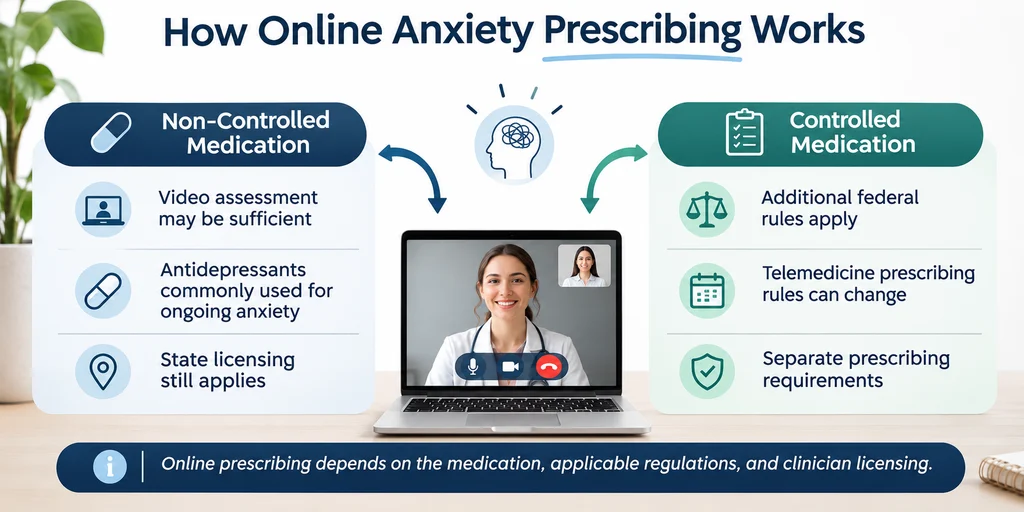
For most anxiety medications, yes. A video appointment is enough to be assessed and prescribed the antidepressants usually used for ongoing anxiety treatment, since those are not controlled substances. Your prescriber does need to hold a license in the state you are physically in at the time of the appointment.
Controlled substances sit under a separate set of federal rules. The Drug Enforcement Administration and the Department of Health and Human Services [3] have extended telemedicine prescribing flexibilities for controlled medications four times on a temporary basis, so what is permitted in that category can change from one year to the next.
If a service advertises a specific drug before anyone has assessed you, that is the wrong order. Checking who holds the license, what the appointment actually involves, and how follow-up is handled tells you more about whether an online psychiatry appointment is legitimate than the website design does. The licensing rule matters again if you move or travel, so tell your prescriber in advance when you will be out of state, especially as a follow-up approaches.
What Does Follow-Up Look Like?
A review within a few weeks, then at longer intervals. Antidepressants for anxiety work over weeks instead of days, so the first follow-up is mostly about side effects and tolerance rather than whether you feel better yet. Doses often start low and increase from there, which is planned, not a setback.
A Cochrane review of antidepressants for generalized anxiety disorder [4] pooled 37 trials and 12,226 people. It found antidepressants did better than placebo at halving anxiety symptoms and at reaching remission, improved quality of life, and were no harder to stay on overall than placebo.
More people stopped because of side effects on an antidepressant than on placebo, and fewer stopped because it was not working, which is roughly what the first few weeks feel like from the inside. The trials also excluded people with medical conditions and included few with other psychiatric diagnoses, so the average result may not match someone carrying both. At the first review, a prescriber needs specifics: what changed, what got worse, and roughly when each happened.
Asking the Question Does Not Commit You to Anything
Asking about medication can feel like asking for a favor. Or like admitting the coping has stopped working. Or like the start of a conversation where you have to justify why you deserve the appointment at all. Many people put it off for a year or more over exactly that.
At MindVita, nobody needs to make a case for being there. A board-certified psychiatric nurse practitioner works through what you have been living with, what has and hasn’t helped, and what your physical health adds, then lays out the options and what each one involves. Appointments are available at our Vienna office (8000 Towers Crescent Drive, Floor 13, Vienna, VA 22182) or by telehealth anywhere else in Virginia. Book an anxiety consultation and bring the specifics.
FAQs
Can I ask for a specific anxiety medication by name?
Yes, and prescribers would rather you did. Knowing a friend did well on something, or that you reacted badly to it years ago, is information they cannot get anywhere else. It can’t settle the choice, which depends on your history, your other prescriptions, and what your body tolerates.
Will I be asked to try therapy first?
Sometimes, depending on the severity and what you have done so far. For milder anxiety, a prescriber may suggest starting with therapy, while more severe symptoms often make medication part of the plan from the start. Naming the approaches you have tried before and how each went shortens that discussion.
What if I only need something for occasional situations?
Mention it at the start, because it is a different conversation from daily treatment. Medication intended for specific situations is prescribed for different reasons, and whether it suits you depends on how often those situations arise and what else is going on. Bring it up early, since it can change the plan’s direction.
What if I do not want to take medication long-term?
Say that at the first appointment, because it changes the plan. Some people take an antidepressant for a defined stretch and then review it with their prescriber, and stopping is done gradually instead of suddenly. Having that intention on the record from the start makes the review a scheduled step.
Can my primary care doctor take over the prescription later?
Often, once things are stable. Some people are started by a psychiatric prescriber and handed back to their family doctor for refills, with a referral back the other way if symptoms change or the medication stops working. Ask how that handover works, because it decides who you call when something comes up.
References
- Code of Virginia. “§ 54.1-2957.01. Prescription of certain controlled substances and devices by licensed advanced practice registered nurses.” https://law.lis.virginia.gov/vacode/54.1-2957.01/
- U.S. Preventive Services Task Force. “Anxiety Disorders in Adults: Screening.” June 2023. https://www.uspreventiveservicestaskforce.org/uspstf/recommendation/anxiety-adults-screening
- Drug Enforcement Administration and U.S. Department of Health and Human Services. “Fourth Temporary Extension of COVID-19 Telemedicine Flexibilities for Prescription of Controlled Medications.” Federal Register, December 31, 2025. https://www.federalregister.gov/documents/2025/12/31/2025-24123/fourth-temporary-extension-of-covid-19-telemedicine-flexibilities-for-prescription-of-controlled
- Kopcalic K, Arcaro J, Pinto A, et al. “Antidepressants versus Placebo for Generalised Anxiety Disorder (GAD).” Cochrane Database of Systematic Reviews. 2025. https://www.cochranelibrary.com/cdsr/doi/10.1002/14651858.CD012942.pub2/full