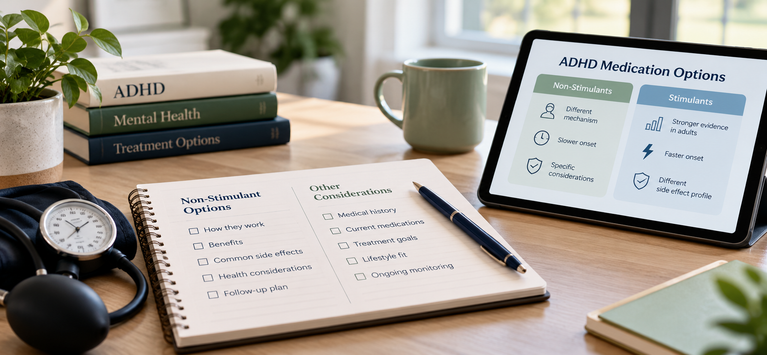

Two non-stimulants carry FDA approval for ADHD in adults: atomoxetine and viloxazine. They work differently from stimulants, and neither is automatically the safer option. Which one suits you, if either does, depends on your health history, what you can tolerate, and what you are hoping to avoid by not taking a stimulant.
If you are weighing this up, it is a comparison to make with someone who can see your whole history. At MindVita, you can bring what you have already tried and what you reacted badly to, and we work from that rather than from a default. You can book a medication consultation to review your options.
What Are Non-Stimulant ADHD Medications?
Medications that treat ADHD without acting as stimulants. They act on norepinephrine rather than working the way stimulants do, which changes how quickly they act and what side effects they carry. You will also see them written as nonstimulant ADHD meds, and the category is smaller than most people assume.
The evidence behind them is real but not equal to stimulants in adults. A network meta-analysis in The Lancet Psychiatry [1] pooled 133 randomized trials, 51 in adults, and found that atomoxetine and bupropion both outperformed placebo on clinician-rated symptoms, while amphetamines produced the largest effect and were the authors’ preferred short-term first choice for adults.
That matters for how you read the rest of this. The same analysis found atomoxetine was less well tolerated than placebo, with more people stopping because of side effects. Trading a stimulant for a non-stimulant doesn’t eliminate side effects, and it doesn’t necessarily improve effectiveness.
Which Non-Stimulant ADHD Medications Are Approved for Adults?
Atomoxetine and viloxazine. Both are approved for ADHD in adults and in children from six years upward, and they are the only two with an adult ADHD indication. Anything else you hear about is being prescribed off-label, which is a legitimate practice but a different conversation to have with your prescriber.
Both approvals are specific. The FDA label for atomoxetine [2] covers ADHD in adults and in pediatric patients six years and older, and the label for viloxazine [3] uses almost identical wording. The two differ in the warnings, not in who they are approved for.
The groups worth separating are these.
Atomoxetine
The longer-established of the two. Its boxed warning for suicidal thinking applies to pediatric patients, and the label reports no increased risk in the adult analyses.
Viloxazine
The newer of the two. Its boxed warning does cover adults because trials found higher rates of suicidal thoughts and behaviors with it than with placebo.
Off-Label Options
Bupropion is approved for depression and smoking cessation, not ADHD, so using it here is off-label even though the meta-analysis found it beat placebo in adults.
Guanfacine and clonidine also come up in these conversations, usually in their extended-release forms, and your prescriber can tell you whether a particular product’s approval covers adults. Off-label prescribing is normal and lawful. It means the decision rests more on your prescriber’s judgment than on a tested indication.
How Long Do They Take, and What Happens at Follow-Up?
Neither label states a time to effect. They do show how long the trials ran: the adult studies lasted six weeks for viloxazine and ten weeks for atomoxetine, with results measured at the end. In practice, follow-up focuses on monitoring rather than simply waiting to see how you feel.
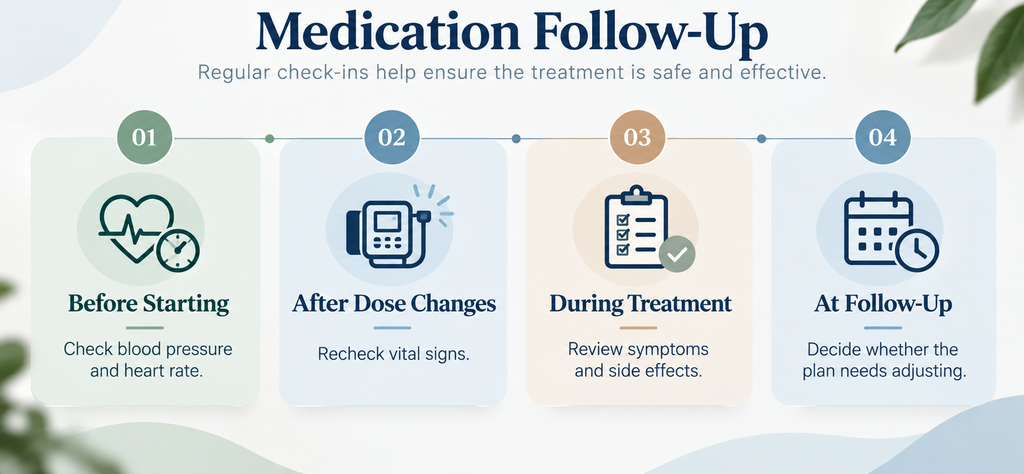
The viloxazine label [3] specifies when checks occur. Clinicians assess heart rate and blood pressure before starting, after any dose increase, and periodically during treatment. It also directs close monitoring for clinical worsening and for emerging suicidal thoughts, which is why the first few appointments tend to sit closer together than later ones.
That schedule is the substance of medication management for these drugs. Stimulant prescribing runs on a different footing, with its own rules about refills and controlled substances, set out in the online ADHD medication guide.
What Side Effects and Health History Matter?
Cardiovascular history matters most, and the idea that non-stimulants avoid heart effects is wrong. Both can raise blood pressure and heart rate in some people, and one also carries a liver warning. What you disclose before starting changes which option is even on the table for you.
- Any heart condition, high blood pressure, or family history of sudden cardiac death
- Liver problems, past or present, including anything that showed up on blood work
- Any history of suicidal thoughts, in you or in close family
- Every other medication and supplement you take, including over-the-counter ones
- What happened the last time a psychiatric medication did not agree with you
The atomoxetine label [2] is explicit about this. It contraindicates the drug in severe cardiac or vascular disorders that would deteriorate with a clinically important rise in blood pressure or heart rate, reports tachycardia, orthostatic hypotension, and syncope, and notes postmarketing reports of sudden death, stroke, and myocardial infarction in adults.
Liver injury is the other label warning to know about. Postmarketing reports include severe liver injury and rare liver failure, most beginning within the first 120 days, and the label says to stop the drug and not restart it if jaundice or laboratory evidence of liver injury appears. Atomoxetine also appears among the medications covered in MindVita’s article on photosensitivity with psychiatric medications, which is a separate consideration if you spend a lot of time in the sun.
What Should You Ask at a Medication Consultation?
Ask about fit rather than about which drug is best, because the answer depends on things only your history can settle. A good consultation covers what you have already tried, what your blood pressure and heart rate are doing now, and what trade-offs you would consider acceptable in terms of side effects.
- Does my cardiac or liver history rule out either option?
- Which boxed warning applies to someone my age?
- How will you check my blood pressure and heart rate, and how often?
- How long before we decide whether this is working?
- If this one does not suit me, what comes next?
Bring your own list as well. The most useful thing you can give a prescriber is a short record of what you took, when you stopped, and what specifically made you stop, because that narrows the options faster than any general preference about stimulants.
Book a Medication Consultation Before You Rule Anything Out
You have read that non-stimulants are gentler and also that they barely work. You have a blood pressure reading; you are not sure it matters. Something you tried years ago gave you side effects nobody explained. And the one question you actually want answered, whether either of these fits you, needs your history to answer.
At MindVita, you can compare options with a psychiatric nurse practitioner instead of narrowing them down on your own. Care comes from board-certified advanced practice providers, not psychiatrists, and we see people at our Vienna office or over secure video, where your provider is licensed. Bring your blood pressure numbers and your list of what went wrong before. You can book a medication consultation and leave with a plan, not a shortlist.
FAQs
Can I switch from a stimulant to a non-stimulant without a gap in treatment?
Usually that is planned rather than done abruptly, and the sequencing is your prescriber’s call. Some people overlap the two briefly, others stop one before starting the other, and which applies depends on why you are switching. Raise it as a plan at the appointment instead of adjusting anything yourself.
Are non-stimulants easier to get prescribed?
Not necessarily easier, though the paperwork differs, since they are not scheduled the way stimulants are. You still need an assessment, a prescriber who thinks the medication fits your situation, and follow-up afterward. No service can promise a particular prescription before anyone has reviewed your history.
Can a non-stimulant be taken alongside a stimulant?
Sometimes, and that combination is a prescriber decision rather than something to assemble yourself. It comes up when a stimulant helps but not for long enough, or not for every symptom. The monitoring gets more involved when two medications are running, so expect closer follow-up if that is the plan.
Will my insurance cover a non-stimulant?
That depends on your plan’s formulary, and checking before the appointment saves time afterward. Some plans prefer one of the two options, and some ask you to try a stimulant first. Your prescriber can often help with the paperwork if an exception is needed, though no particular outcome is guaranteed.
Do non-stimulants help the emotional side of ADHD?
Some people report that, though the trials measured core symptoms rather than emotional regulation, the evidence is thinner than the anecdotes. If emotional reactivity is your main concern, say so directly, because it may change which option your prescriber suggests and what else they want to assess alongside it.
References
- Cortese S, Adamo N, Del Giovane C, et al. “Comparative Efficacy and Tolerability of Medications for Attention-Deficit Hyperactivity Disorder in Children, Adolescents, and Adults: A Systematic Review and Network Meta-Analysis.” The Lancet Psychiatry. 2018. https://ora.ox.ac.uk/objects/uuid:9ed03118-b428-494a-a0a8-1d784164d694
- U.S. Food and Drug Administration. “Strattera (Atomoxetine Hydrochloride) Prescribing Information.” https://www.accessdata.fda.gov/drugsatfda_docs/label/2026/021411s053lbl.pdf
- U.S. Food and Drug Administration. “Qelbree (Viloxazine Extended-Release Capsules) Prescribing Information.” DailyMed, National Library of Medicine. https://dailymed.nlm.nih.gov/dailymed/drugInfo.cfm?setid=aedf408d-0f84-418d-9416-7c39ddb0d29a