

Do certain situations, places, or objects trigger intense fear even when you know they are not dangerous? You may avoid specific activities, social situations, or environments because the anxiety feels difficult to manage. Understanding the different types of phobias can help you recognize fear patterns and better understand how they affect your thoughts, emotions, and daily life.
If phobias are affecting your daily routine, you may start avoiding situations that once felt manageable. Over time, these fears can impact your confidence, relationships, work, or school performance. At MindVita, our psychiatric providers help you understand the source of your fears and develop practical strategies to manage anxiety more effectively. Through personalized support and evidence-based care, we help you build confidence and regain greater control over your daily life. Schedule a consultation today to start your journey toward a calmer and more controlled life.
What Are Phobias and Why Do They Go Beyond Normal Fear?
Phobias are anxiety disorders that cause intense and lasting fear of specific objects, situations, or activities. Unlike normal fear, which appears during real danger, phobias trigger strong emotional and physical reactions even when little or no threat exists. As a result, you may begin avoiding certain places, experiences, or interactions. Over time, this fear can affect your daily routine, relationships, career, education, and quality of life.
According to the Canadian Psychological Association (CPA) [1], phobias involve intense fear that is much stronger than the actual level of danger. These fears may develop through past experiences, learned responses, or repeated patterns of avoidance. Over time, avoiding the feared object or situation can reinforce the fear and make symptoms more persistent.
What Are the Main Types of Phobias?
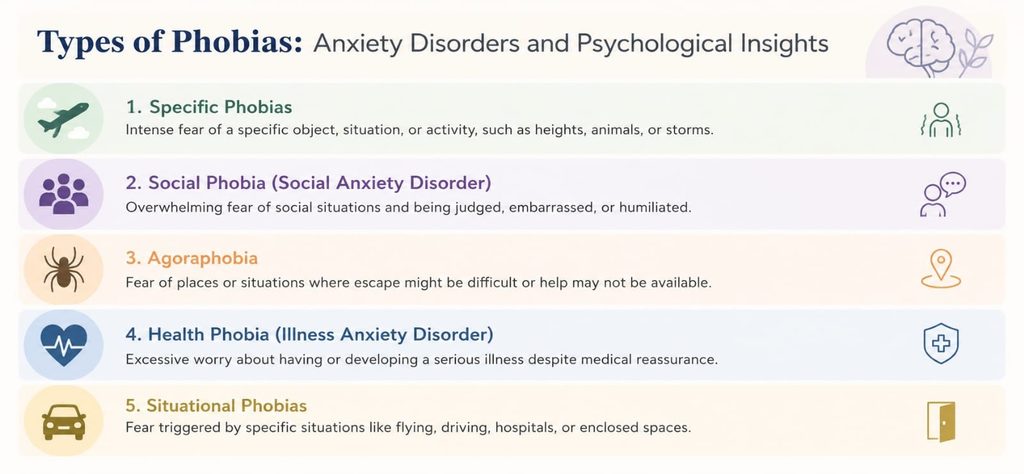
Mental health professionals generally classify phobias into three main categories: specific phobias, social anxiety disorder (social phobia), and agoraphobia. While all phobias involve intense fear and anxiety, each category has different triggers, symptoms, and effects on daily life. Learning how phobias are classified can help mental health professionals identify the underlying fear pattern and recommend the most appropriate treatment approach.
- Specific Phobias: Fear of heights, spiders, flying, injections, storms, or enclosed spaces.
- Social Anxiety Disorder (Social Phobia): Fear of social situations where you may feel judged, embarrassed, criticized, or closely observed by others.
- Agoraphobia: Fear of places or situations where escape may feel difficult or where help may not be available during anxiety symptoms.
Recognizing these categories can help explain why different phobias affect people in different ways. Some individuals fear specific objects or situations, while others struggle with social interactions or being in places where escape feels difficult. As a result, identifying the correct category is an important step toward finding the right support, improving daily functioning, and achieving better mental health.
How Can Phobias Affect Your Daily Life?
Phobias affect more than your immediate fear response. You may begin avoiding situations, places, or activities that trigger anxiety. Over time, this avoidance can interfere with work, school, relationships, travel, and personal goals. Some people spend significant time worrying about encountering their fear, which can increase anxiety, reduce confidence, and make everyday activities more challenging.
As avoidance grows, opportunities for social interaction, career development, or enjoyable experiences may become limited. Understanding how phobias affect everyday functioning can help you recognize when professional support may be beneficial and encourage you to seek treatment before symptoms become more disruptive.
How Do Psychological Mechanisms Explain the Development of Phobias?
Phobias develop through a mix of thoughts, experiences, and biological factors. Your brain may begin to see a harmless object or situation as dangerous. As a result, even a small trigger can create intense fear. In some cases, a past negative experience or repeated exposure to fear-based messages can strengthen these reactions over time and make them more difficult to ignore.
Research from the PMC scientific review article [2] explains that phobias develop through a combination of conditioning and the brain’s fear-response system. When you keep avoiding what you fear, your brain learns to continue treating it as a threat. As a result, the fear becomes stronger and lasts longer. These mechanisms show how learning experiences and brain function work together in the development and persistence of phobias.
What Are the Treatment Options for Phobias and Anxiety Disorders?
Phobias and anxiety disorders can be managed through different treatment approaches that help you reduce fear reactions and improve daily functioning. The focus is on changing how your mind reacts to triggers and building a sense of control. Treatment plans are usually based on your symptoms, severity, and personal needs. With the right support, you can gradually reduce fear and improve emotional stability in real-life situations.
Cognitive Behavioral Therapy (CBT)
CBT helps you understand how your thoughts influence fear. During therapy, you learn to identify unhelpful thinking patterns and replace them with more balanced and realistic responses. Over time, this can reduce fear and make situations feel more manageable.
Gradual Desensitization Training
This method helps you slowly become less sensitive to fear triggers. You are exposed to small, manageable levels of the feared situation first. This step-by-step process helps your brain learn that the fear is not real danger. As a result, your anxiety response becomes weaker with repeated practice.
Medication Support
In some cases, medication may be used to help reduce strong anxiety symptoms. These medicines can support you during treatment, especially when fear reactions are severe or difficult to manage with therapy alone.
According to Medical News Today [3], cognitive behavioral therapy and exposure-based approaches are among the most effective treatments for phobias. In some situations, medication may also
be added to control symptoms. These approaches are often combined to help you manage fear better and improve daily functioning. With proper treatment, many people learn to manage phobias more effectively and experience meaningful improvements in daily functioning.
Take Control of Phobias and Start Your Mental Wellness Journey with MindVita Today
Living with phobias can make everyday situations feel much harder than they should. You may avoid certain places, situations, or activities because they make you feel afraid. As a result, your world can start to feel smaller. This fear may affect your confidence, relationships, work, or studies. Over time, you may feel frustrated because fear keeps stopping you from doing things you want or need to do.
At MindVita, we help you understand your fears and learn ways to manage them. Our psychiatric providers use evidence-based approaches to help you better understand fear responses and develop practical skills for managing them. With the right guidance, you can reduce anxiety, face feared situations with greater confidence, and enjoy a calmer and more balanced life. Contact us today and take the first step toward overcoming phobias and building a healthier, more confident future.
FAQS
Can phobias develop without any traumatic experience?
Yes, phobias can develop without any traumatic experience. Genetics, brain sensitivity, or learned behavior from others can play a role. Sometimes the brain learns to associate certain situations or objects with fear even when no real danger exists. Over time, repeated thoughts or anxiety patterns can build phobias even without a clear past event or direct harmful experience in life.
Why do phobias feel so real even when I know there is no danger?
Phobias feel real because your brain reacts before logic works. Your brain’s fear-response system can trigger strong physical and emotional reactions even when no real danger exists. Over time, these responses become automatic and make fear feel real and hard to control.
Can phobias get worse if left untreated?
Yes, phobias can get worse if left untreated. Avoiding feared situations often increases fear over time. Your brain keeps reacting strongly in similar moments. Without help, symptoms may spread into daily life. Timely guidance and small steps toward facing fear can help you feel calmer and regain steady emotional balance.
Do phobias always require medication for recovery?
No, phobias do not always need medication for recovery. Many people improve with therapy like CBT and gradual exposure. Medication is only used in severe cases when anxiety is very strong. With proper guidance and support, you can manage phobias naturally and build better control over fear responses safely over time.
When should I seek professional help for a phobia?
You should consider professional help when a phobia begins affecting your daily life, relationships, work, school performance, or ability to complete routine activities. If fear leads to ongoing avoidance, emotional distress, or significant anxiety, treatment can help you manage symptoms and regain confidence.
Is it possible to have more than one type of phobia at the same time?
Yes, you can experience more than one phobia at the same time. This can occur because different anxiety disorders may share similar psychological and biological factors. For example, you may have social phobias and specific phobias together. As a result, fear responses increase and affect your daily life in multiple situations.




2 Responses