

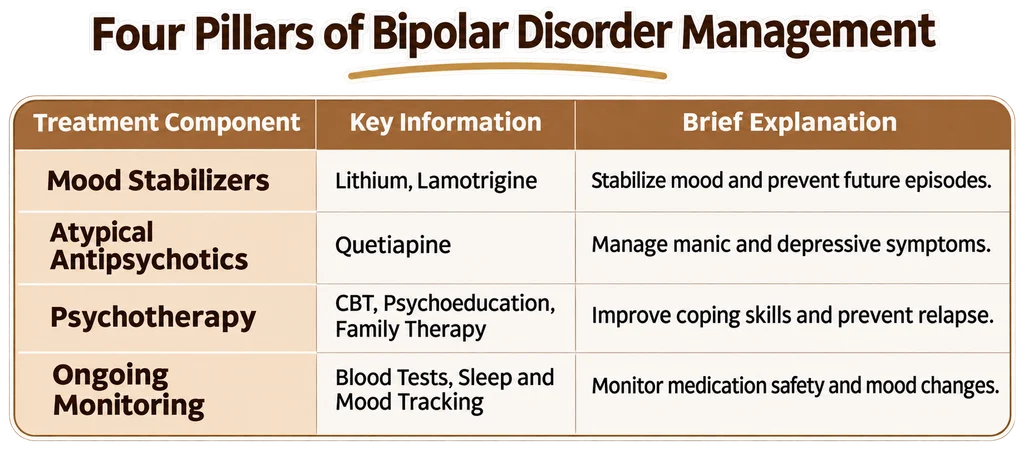
Bipolar disorder treatment combines medication with therapy, and it is built around keeping the next episode away rather than only treating the current one. Which medications suit you depends on whether mania or depression is the bigger problem, and the plan gets adjusted over time instead of being set once and left alone.
If you have a diagnosis and no ongoing plan yet, that gap is the thing to close. At MindVita, the prescribers who manage bipolar treatment are psychiatric nurse practitioners (PMHNP-BC), seeing patients in Vienna or by telehealth elsewhere in Virginia. You can book a bipolar medication-management evaluation and bring whatever records you have.
How Is Bipolar Disorder Treated?
With medication as the foundation and therapy alongside it, over years rather than weeks. Treatment for bipolar disorder works in two phases: settling an acute episode, then holding off the next one. Most people stay on medication through the quiet periods too, because that is when the preventive work is actually being done.
The National Institute of Mental Health [1] states that bipolar disorder usually requires lifelong treatment, and that an effective treatment plan can help people manage their symptoms and improve their quality of life. Lifelong is the word that lands hardest in that sentence, and it is also why the plan is worth building properly early on.
Which is a different proposition from treating a one-off episode. Whether you have bipolar disorder at all is a question that gets settled before any of this, and the answer shapes everything after it, because treatment for bipolar depression is not the same as treatment for depression on its own.
Medication Options to Discuss With a Prescriber
Mood stabilizers and atypical antipsychotics, mostly, with the choice depending on which direction your episodes go. No medication covers mania and depression equally well, which is why plans often combine two. None of this is a menu to order from, and the specifics belong to your prescriber rather than to an article.
The VA and Department of Defense bipolar guideline [2], summarized in American Family Physician, splits its recommendations by phase. For acute mania it points to lithium or quetiapine. For bipolar depression it points to quetiapine. For maintenance it reports lithium and quetiapine as the strongest options against mania, and lamotrigine as the strongest against depressive recurrence while noting that lamotrigine does not prevent mania.
That phase split explains more than anything else on the subject.
Why Two Medications Is Common
One agent that prevents mania may do nothing for depression, and the reverse holds too, so a maintenance plan often pairs them to cover both directions.
Lithium
Still the reference point after decades, and the guideline rates it at the top for acute mania and for preventing its return. It also demands more monitoring than the alternatives.
Lamotrigine
Better at holding off depressive episodes than at preventing mania, which is why it rarely stands alone. The guideline also notes it does not treat acute bipolar depression.
Atypical Antipsychotics
Quetiapine appears across all three phases in the guideline, which is unusual. Others sit second-line for bipolar depression mainly because of their side effect profiles.
Antidepressants
Not recommended on their own for bipolar depression, and the guideline found insufficient evidence that adding one to a mood stabilizer improves depressive symptoms either.
Which of these you end up on depends on your own episode history, what you have tolerated before, and whether you are pregnant or planning to be. Bipolar I and bipolar II are treated differently as well, so the type on your chart matters here.
What Is the Role of Therapy?
Preventing the next episode, mostly, and it works better alongside medication than in place of it. Therapy for bipolar disorder is less about exploring the past than about spotting early warning signs, protecting sleep and routine, and getting the people around you involved in noticing what you often cannot see yourself.
A component network meta-analysis in JAMA Psychiatry [3] pooled 39 randomized trials and 3,863 people to work out which parts of therapy do the work. The analysis ranked family or conjoint therapy highest for preventing recurrence, and found that cognitive behavioral therapy, standard psychoeducation and brief psychoeducation all did better than usual care on the same measure.
Psychoeducation and self-monitoring worked better in a family or group format than one to one, which is an argument for bringing someone with you. And for mania specifically, no therapy differed significantly from usual care, a reminder that therapy supplements medication instead of standing in for it. Our medication management runs alongside therapy for that reason.
What Do Monitoring and Follow-Up Visits Involve?
Blood tests for some medications, a review of how you have been between visits, and a check on side effects. Follow-up sits closer together at the start and after any change, then spaces out. The point is catching a shift early, while it is still small enough to act on.
- Sleep, especially any stretch of needing much less of it
- Mood changes and how long each one lasted
- Side effects, including the ones you have decided to put up with
- Any other medication, supplement, or over-the-counter product you have started
- Alcohol and other substance use, described accurately
The FDA prescribing information for lithium [4] carries a boxed warning that lithium toxicity is closely related to blood concentrations and can occur at doses close to the therapeutic range. It directs that kidney function be assessed before and during treatment, with thyroid function checked before starting and periodically afterwards, and warns that dehydration from sweating, diarrhea, or fever raises the risk, as can common painkillers and diuretics.
Some changes should not wait for the next appointment. Sleep collapsing, spending or risk-taking climbing, or any thought of ending your life all belong in a same-day call. The 988 Suicide and Crisis Lifeline [5] answers by phone, text and online chat around the clock at no cost, and 911 is the right number when safety is at stake right now. Never stop or alter a dose on your own to deal with a side effect.
How Do You Get Bipolar Treatment in Virginia, in Person or by Telehealth?
By booking with a prescriber who handles bipolar disorder treatment specifically, in an office or over video. Telehealth covers everywhere outside the office itself, so the practical questions are usually who has availability and whether you want that first appointment face to face before settling into video for the longer term.
Our own setup is one office and the rest by video. The office is in Vienna, close to Tysons, and everywhere outside it is telehealth. Prescribing and reviews sit with psychiatric nurse practitioners, therapy with licensed clinical social workers, so both halves of the plan live under one roof.
One practical thing to settle early is where the blood work happens. Some practices draw it on site, others send you to a lab and read the results at the following visit, and that changes how quickly a problem gets spotted. Ask at the first appointment instead of discovering it three months in.
A Diagnosis Is Not a Plan
The diagnosis arrives and then very little does. Maybe it came from a hospital stay, or a primary care doctor who started something and said to follow up with someone else. Months later there is a prescription nobody has reviewed, no therapy, and no clear idea of who is actually in charge of this.
At MindVita, being in charge of it is the job. A psychiatric nurse practitioner takes the diagnosis you already have, reviews what you are on and what it has done so far, and builds the maintenance side that usually goes missing: the medication, the monitoring schedule, and therapy running alongside. Our office is at 8000 Towers Crescent Drive, Floor 13, Vienna, VA 22182, with video for the rest of the state. Bring the discharge papers, the old prescriptions and whatever dates you can find, and book a bipolar medication-management evaluation.
FAQs
Can medication ever be reduced or stopped?
Sometimes, and it is a decision for your prescriber to make, not a solo experiment. Doses are reviewed and occasionally reduced, usually after a long stable stretch and with closer monitoring during the change. Stopping on your own is a common route back into an episode, which is why you should raise it instead of acting on it.
Does bipolar II need medication as well?
Yes, in most cases. Bipolar II involves hypomania instead of full mania, and the depressive side often dominates, so the medication choice differs while the principle stays the same. Treating only the depression without covering the other direction is the risk a prescriber is working around when choosing a combination.
How long before a mood stabilizer starts to help?
Weeks for the preventive effect, though acute mania often responds sooner. The first few weeks are mostly about tolerating the medication, so judging whether it works that early can be misleading. Your prescriber will want to hear about side effects well before you can tell whether it is helping.
Is weight gain unavoidable on these medications?
Not unavoidable, and not unusual either. Some of these medications are more associated with weight change than others, which is one factor a prescriber considers when choosing between options. Raise it before you start, not after, because it influences which one you are offered in the first place.
Can I drink alcohol while on bipolar medication?
Ask your prescriber about your specific medication, because the answer varies. Alcohol interacts with several of these drugs, worsens sleep, and can destabilize mood on its own, which makes it a bigger factor here than in many other conditions. Be straight about how much you drink when you are asked.
References
- National Institute of Mental Health (NIMH). “Bipolar Disorder.” https://www.nimh.nih.gov/health/topics/bipolar-disorder
- “Management of Bipolar Disorder: Guidelines From the VA/DoD.” American Family Physician. June 2024. https://www.aafp.org/afp/2024/0600/practice-guidelines-bipolar-disorder.pdf
- Miklowitz DJ, Efthimiou O, Furukawa TA, et al. “Adjunctive Psychotherapy for Bipolar Disorder: A Systematic Review and Component Network Meta-analysis.” JAMA Psychiatry. 2021. https://jamanetwork.com/journals/jamapsychiatry/fullarticle/2771207
- U.S. Food and Drug Administration. “Lithium Carbonate Prescribing Information.” DailyMed, National Library of Medicine. https://dailymed.nlm.nih.gov/dailymed/drugInfo.cfm?setid=d20ed2aa-aa56-4709-9e7a-9243c71465c9
- 988 Suicide & Crisis Lifeline. Official website. https://988lifeline.org/