

Cost is often the first question people have before starting psychiatric care, and it is a fair one. Does insurance cover a psychiatrist? In many cases it does, including ongoing medication management visits. What catches most people off guard is how much their final cost can change based on a few details in their plan.
Knowing your coverage ahead of time can make the next step feel much less uncertain. At MindVita, you can meet with a qualified psychiatric provider, including a psychiatric nurse practitioner who can assess your symptoms, prescribe medication when appropriate, and provide ongoing medication management. In-network benefits are available with plans from insurers such as Aetna, Anthem, Cigna, and UnitedHealthcare, and no extra fees are added to visits when you use your insurance. Appointments are available at the Tysons office or through secure video, and when you are ready, you can book an appointment directly.
Does Insurance Cover Psychiatry?
Many health insurance plans include coverage for mental health care, including psychiatric evaluations and ongoing medication management. Still, coverage is not automatic or identical across plans. Two people with insurance from the same company can pay very different amounts depending on the plan they chose.
According to HealthCare.gov [1], all plans sold through the Health Insurance Marketplace cover mental health and substance use disorder services as essential health benefits. These plans also cannot refuse to cover you or charge you more because of a preexisting condition, including a mental health condition.
What Psychiatric Medication Management Includes
Many people search for a psychiatrist when they want help with medication for conditions such as depression, anxiety, or ADHD. Medication management is the ongoing care that follows. It usually starts with an initial evaluation, where your provider learns about your symptoms, history, and goals. Follow-up visits are then used to check how a medication is working, watch for side effects, and adjust the plan when needed. If you are still deciding whether you need medication support, therapy, or both, it can help to understand the difference between a therapist and a psychiatrist.
At MindVita, medication management is provided by board-certified advanced practice providers who treat a range of adult and pediatric mental health conditions. Insurance typically treats these appointments as outpatient mental health visits, so your plan’s outpatient mental health benefits are usually the place to start when checking coverage.
What Can Affect Your Cost With Insurance
Even when psychiatric care is covered, your share of the cost can vary quite a bit from one plan to another. Federal parity law helps keep these costs fair. According to the U.S. Department of Labor [2], when a plan offers both medical and mental health benefits, it must treat copays, deductibles, coinsurance, and visit limits comparably. This means a plan generally should not set stricter financial or visit limits on mental health care than on similar medical care.
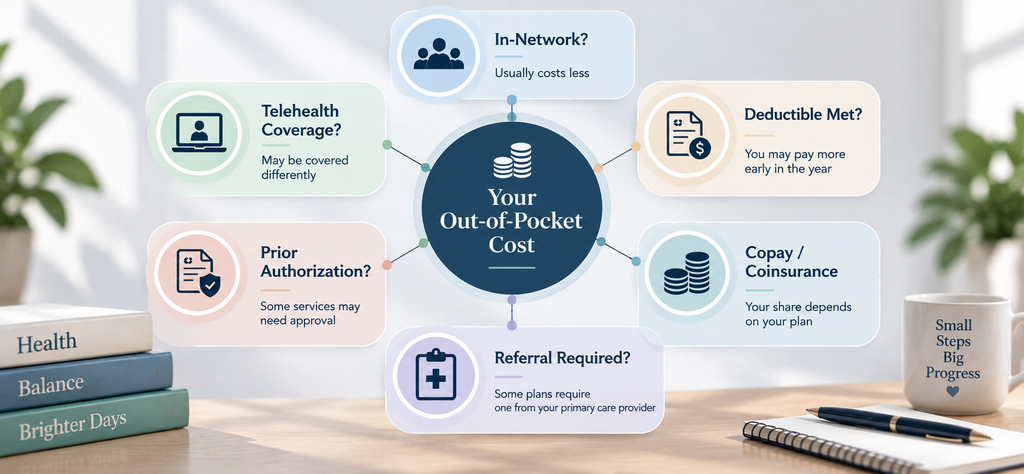
The main factors that affect your cost usually include:
- Whether the practice is in-network or out-of-network with your plan
- How much of your yearly deductible you have already met
- Your copay or coinsurance for outpatient mental health visits
- Whether your plan requires a referral or prior authorization
- Whether telehealth visits are covered the same way as in-person visits
An initial evaluation often takes longer than a follow-up visit, so your cost for the first appointment may be different from later visits. If you have a high-deductible plan, you may pay more early in the year and less once your deductible is met.
Visits and Prescriptions Are Usually Covered Separately
It helps to know that your appointment and your medication are often handled under different parts of your plan. Your visit with a provider falls under your medical or mental health benefits, while prescriptions are usually covered through your pharmacy benefit.
Each plan has its own list of covered medications, often called a formulary. Some medications may cost more than others, and some may need prior authorization before your plan will pay for them. If a prescribed medication is not covered or is expensive, your provider may be able to discuss other options that fit your plan and your clinical needs. For a general overview before your appointment, MindVita’s guide to psychiatric medications covers common treatment options.
Medicare and Medicaid Coverage
If you have Medicare, the rules work a little differently. According to Medicare.gov [3], Medicare Part B covers outpatient mental health services, including psychiatric evaluation and medication management. After you meet the Part B deductible, you generally pay 20% of the Medicare approved amount for visits to diagnose or treat your condition. Virginia’s Medicaid program also includes coverage for behavioral health services for eligible members.
Not every practice participates in these programs. MindVita works with commercial insurance plans and does not accept Medicare or Medicaid, so if you are covered by either one, you would need to find a provider who participates in your plan.
Does Health Insurance Cover a Psychiatrist in Virginia?
Where your plan comes from can affect which rules apply and where you can go with questions. In Virginia, many individual plans and fully insured employer plans are regulated by the state.
The Centers for Medicare & Medicaid Services [4] directs Virginians who bought their own coverage, or who have insurance through an employer that does business only in Virginia, to the State Corporation Commission’s Bureau of Insurance for help with insurance questions. Many large employers, however, use self-funded plans, which are governed mainly by federal rules. Your plan documents or HR department can usually tell you which type you have.
MindVita is in-network with a wide range of commercial plans, including:
- Aetna, Cigna and Evernorth, and Optum
- Anthem, Anthem EAP, Blue Cross, BlueCross BlueShield, and CareFirst
- UnitedHealthcare, along with UMR, Oxford, Golden Rule, All Savers, Surest, and UnitedHealthcare Student Resources
- Oscar Health, Quest Behavioral Health, Meritain Health, Wellpoint, Curative, and the Government Employees Health Association (GEHA)
- Regional Blue Cross plans, including Empire BlueCross BlueShield, Excellus BlueCross BlueShield, Horizon Blue Cross and Blue Shield, Independence Blue Cross, Premera Blue Cross, Providence, and Regence
Networks and individual policies change from time to time, so confirm that your specific plan is accepted before you book.
Telehealth is another thing to check. Many plans cover online psychiatric visits, but benefits can differ from in-person care. You may also need to be physically located in a state where your provider is licensed during the appointment, depending on applicable telehealth requirements.
How Much Does a Psychiatrist Cost Without Insurance?
If you do not have insurance or choose not to use it, you will pay the practice’s self-pay rate. The cost of seeing a psychiatric provider without insurance can vary based on the type of provider, the length of the visit, the location, and how often you need follow-up care. Initial evaluations usually cost more than follow-up appointments because they take more time.
Paying out of pocket does come with certain protections. The Centers for Medicare & Medicaid Services [5] explains that under the No Surprises Act, providers usually must give you a Good Faith Estimate of expected charges when you are not using insurance and schedule care at least three business days ahead or ask for one. If your final bill is at least $400 more than the estimate, you may be able to dispute it.
At MindVita, medication management is $275 for the initial psychiatric evaluation and $165 for each follow-up appointment. Separate fees can apply for missed appointments, late cancellations, or paperwork requests, so it is worth asking about that policy when you schedule. You can also review current rates on the pricing page.
Using Out-of-Network Benefits
Some plans include out-of-network benefits. In that case, you may pay the practice directly and then submit a claim to your insurer for partial reimbursement. MindVita can provide a superbill, which is an itemized receipt you can send to your insurer for this purpose. How much you get back depends on your plan’s out-of-network deductible and coverage rules, so it is worth asking your insurer how this works before you start.
How to Check Your Coverage Before Your First Appointment
A quick call to the member services number on your insurance card can save you from unexpected bills. Questions worth asking include:
- Is MindVita in-network with my plan?
- What is my copay or coinsurance for outpatient mental health visits?
- How much of my deductible have I met this year?
- Do I need a referral or prior authorization for psychiatric care?
- Are telehealth mental health visits covered?
- Do I have out-of-network benefits, and how do I submit a claim?
Writing down the name of the representative and the date of your call can be helpful if a billing question comes up later.
Start Psychiatric Care Without the Insurance Guesswork
Maybe you have put off booking because you are not sure your plan covers psychiatric visits, or you worry about a surprise bill after your first appointment. Maybe you already spent time on hold with your insurer and still do not have a clear answer, or you are wondering whether your prescriptions will be affordable. Meanwhile, the trouble focusing, constant worry, low mood, or restless nights keep showing up at work and at home, and not knowing where to start can make it tempting to wait a little longer.
At MindVita, the cost side is kept straightforward. Visits are billed through your in-network benefits with no extra fees added, self-pay rates for initial and follow-up appointments are listed up front, and a superbill is available if you plan to claim out-of-network reimbursement. If you would rather sort out your benefits first, the questions above cover what you need before you book an appointment.
FAQs
Will my employer find out if I use insurance for psychiatric care?
In general, federal privacy rules limit how employer health plans can share your health information with your employer, and plans are not supposed to use it for employment decisions. However, if you are covered under someone else’s plan, such as a parent or spouse, the policyholder may receive an explanation of benefits showing that a visit took place. If privacy is a concern, you can ask your insurer about how and where these statements are sent.
Will my insurance cover visits with a psychiatric nurse practitioner?
The answer opens with “Usually, yes,” then covers cost and points out that MindVita’s providers are advanced practice providers rather than psychiatrists, so readers know why the question matters to them. I also removed the Medicare mention, since the body says MindVita doesn’t accept Medicare and keeping it here would have been confusing.
What happens if my insurance changes in the middle of treatment?
Let the practice know as soon as possible, ideally before your next appointment. Your new plan may have a different network, deductible, or copay. Medications that were covered before may also need a new prior authorization, so it helps to check your prescriptions early to avoid a gap in treatment.
Can I use an HSA or FSA to pay for psychiatric appointments?
Psychiatric care is generally considered a qualified medical expense, so many people can use a health savings account or flexible spending account for appointments and prescribed medications. MindVita accepts HSA and FSA payments, but rules can vary by account type, so check with your account administrator if you are unsure.
What can I do if my insurance denies coverage for psychiatric care?
Start by asking your insurer for the reason in writing. Most plans allow you to file an internal appeal, and if the denial is upheld, many plans also give you the right to an external review by an independent reviewer. Your provider may be able to supply records or a letter explaining why the care is needed.
References
- HealthCare.gov. “Mental Health and Substance Abuse Health Coverage Options.”
- U.S. Department of Labor. “Understanding Your Mental Health and Substance Use Disorder Benefits.”
- Medicare.gov. “Mental Health Care (Outpatient).”
- Centers for Medicare & Medicaid Services (CMS). “Virginia Consumer Assistance.”
- Centers for Medicare & Medicaid Services (CMS). “Know Your Rights When You Aren’t Using Health Insurance.”