

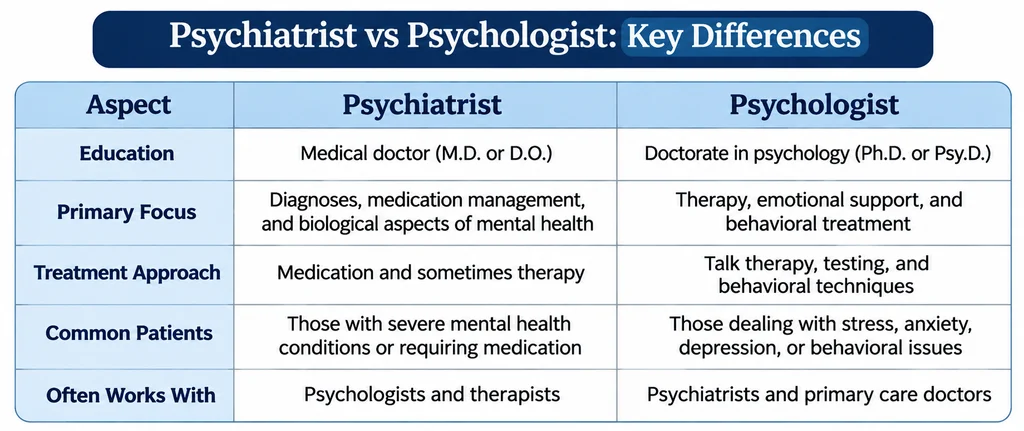
A psychiatrist is a medical doctor who diagnoses mental health conditions and prescribes medication. A psychologist holds a doctorate in psychology and works through assessment and therapy, and in most states cannot prescribe. Which one you need depends on whether you are after medication, talking therapy, or a formal assessment.
If you are not sure which of them you need, that is the most common place to start from. At MindVita, prescribing is handled by psychiatric nurse practitioners (PMHNP-BC) and therapy by licensed clinical social workers (LCSW), in Vienna or by telehealth to the rest of Virginia. You can start with an evaluation and sort it out there.
Psychiatrist vs Psychologist: Training and What Each Does
One trained in medicine, the other in psychology, and that single fact explains most of the rest. A psychiatrist can order blood work, weigh how a physical illness or another drug is affecting your symptoms, and write a prescription. A psychologist assesses and treats through therapy instead, and refers out for medication.
- Psychiatrist: a physician, MD or DO, who diagnoses and prescribes
- Psychologist: a doctoral clinician, PhD or PsyD, who assesses and treats with therapy
- Both diagnose mental health conditions
- Only the psychiatrist prescribes, in all but a handful of states
- Formal psychological testing sits with the psychologist
The American Board of Psychiatry and Neurology [1] requires an MD from an accredited allopathic school or a DO from an accredited osteopathic school, residency training in a program accredited by the ACGME, and a valid unrestricted license to practice medicine. That license has to stay active for the certification to hold.
That license is the practical difference. It is why a psychiatrist can read a thyroid result alongside your mood, and why what a psychiatrist does in an appointment includes dose changes and lab orders a psychologist would have to refer out for. The doctorate on the other side signals research and assessment training, not better conversations.
Who Can Prescribe Medication?
Physicians, nurse practitioners and physician assistants, and in nine jurisdictions psychologists with extra training. Virginia is not one of them. So if medication is what you are after, a psychologist is usually the wrong first appointment, however good the fit might otherwise be. The exceptions are specific, and few people fall inside them.
The Association of State and Provincial Psychology Boards [2] lists nine jurisdictions with prescriptive authority laws for psychologists: Colorado, Idaho, Illinois, Iowa, Louisiana, New Mexico, Utah, Vermont and Hawaii. Getting there takes a master’s degree in clinical psychopharmacology from an approved program, supervised clinical training and a national exam, all on top of the doctorate.
Virginia is not on that list, so for a Virginia reader the shape is straightforward. Therapy and assessment from a psychologist, prescriptions from a medical or nursing prescriber, and what separates a psychiatric nurse practitioner from a psychiatrist in Virginia decides which prescriber that ends up being.
Where Do Therapists and Psychiatric Nurse Practitioners Fit?
In the middle, and that is where most care actually happens. The real choice is rarely just psychiatrist or psychologist. Most people are picking between a psychiatrist, a psychologist and a therapist, and the word therapist covers several licenses that are not psychology doctorates at all, and do not need to be.
The American Psychological Association [3] states that psychologists hold doctoral degrees, that the doctorate is the standard for independent practice, and that under its policy and licensing laws the term psychologist is reserved for people with doctoral education and training. In most states someone holding a master’s is prohibited from using it as a professional title.
The licenses underneath that umbrella are not interchangeable.
Psychiatric Nurse Practitioners
Nurses with graduate training in psychiatric care. They sit on the prescribing side of the line and not the therapy side, which is why they belong in this comparison.
Licensed Clinical Social Workers
Master’s-level clinicians licensed to diagnose and treat mental health conditions with therapy. LCSW is one of the most common therapy credentials in the country, and what our own therapists hold.
Licensed Professional Counselors
Also master’s-level, and licensed for the same diagnostic and therapeutic work. The training sits in counseling rather than social work, and in practice the sessions look much the same.
Marriage and Family Therapists
Licensed to treat individuals as well as couples and families, with training focused on relationships and the systems people live inside rather than on the individual alone.
Psychologists Who Only Do Therapy
Many psychologists in private practice do therapy and no testing at all. If therapy is what you want, their doctorate is not an advantage you will notice in the room.
Which means the honest version of this comparison has three columns, not two. A psychiatrist or a psychiatric nurse practitioner for medication, one of the therapy licenses for the therapy itself, and a psychologist specifically when testing is what the question calls for. Everything after that is about fit.
Which One Should You See First?
Start from what you want to happen, not from the credential on the website. Medication points to a prescriber. Talking therapy points to a therapist, who may or may not be a psychologist. A diagnosis nobody can pin down points to assessment, and that one is genuinely a psychologist’s job.
- You want to try medication: book a prescriber, not a psychologist
- You want therapy and nothing else: a counselor or clinical social worker will do
- You want both: the two are usually arranged alongside each other
- A diagnosis is in doubt after several attempts: ask about psychological assessment
- None of these fits cleanly: an evaluation comes first and the referral follows from it
Formal testing is the clearest case for booking a psychologist specifically. The American Psychological Association [4] describes testing and assessment as two related parts of a psychological evaluation, with testing using norm-referenced instruments so people are measured against the same standard, and assessment taking in interview information, school or medical records and direct observation as well.
It is used to separate dyslexia from attention problems in a child struggling at school, to identify brain injury or dementia through memory and reaction time measures, and to answer questions a school or a court needs documented. Most people asking which professional to see do not need any of that.
Seeing Both: Medication Plus Therapy
Usually as two clinicians on different schedules, which is how most ongoing care runs. A prescriber sees you periodically, mainly to review how the medication is doing. A therapist sees you on a regular rhythm to do the therapeutic work. Neither is attempting the other’s job, and they are not in competition.
Tell each one that the other exists, and say at the start whether you want them in contact. A prescriber who hears what is surfacing in therapy has more to work with than one seeing you alone every few months, and a therapist who knows a dose changed last week reads the following fortnight differently.
Medication and therapy together is the common arrangement rather than the exception, and beginning with one leaves the other open. Many people do therapy for a year before medication comes up, and many start medication and never add therapy at all.

Not Being Sure Is the Normal Starting Point
Two tabs open. One explains that psychiatrists prescribe and psychologists do not. The other insists the distinction barely matters. Neither tells you which number to call, and at the end of the week spent deciding, whatever made you start searching is exactly where it was when you opened the first tab.
At MindVita there is no psychiatrist and no psychologist, and for most of what brings people to this question it changes nothing. Diagnosis, prescribing and dose changes are a psychiatric nurse practitioner’s work. Therapy is a licensed clinical social worker’s. Formal psychological testing is neither, so when that is the real answer we say so and name someone who does it. The question does not have to be answered before you call, because that is what the evaluation is for, at Floor 13, 8000 Towers Crescent Drive, Vienna, VA 22182, with video for patients elsewhere in the state. Bring the confusion with you and start with an evaluation.
FAQs
Is a PsyD different from a PhD in psychology?
Both are doctorates and both lead to the same license. The PsyD is the practice-focused route and PhD programs lean more toward research alongside clinical training, which shows up in what someone has published rather than in what they can treat. For therapy or assessment, the license matters more than the letters.
Does a psychiatrist do therapy as well?
Some do, and fewer than people expect. Psychiatry training covers psychotherapy, but many psychiatrists in outpatient practice concentrate on diagnosis and medication because appointment lengths are built around that. If you want therapy from the same person who prescribes, ask directly before booking, because a directory listing will not tell you.
Can a psychologist tell me whether I need medication?
They can raise it, and in Virginia they cannot write it. A psychologist who thinks medication is worth considering will usually say so and refer you to a prescriber, and their written impression is useful at that appointment. The prescribing decision belongs to whoever holds that authority in your state.
Do I need a diagnosis from a psychiatrist before starting therapy?
No. Therapists assess and treat without waiting for a psychiatric opinion, and most people start therapy without ever seeing a prescriber at all. A formal diagnosis becomes relevant if you want medication, if your insurance requires one, or if something in the picture needs settling before treatment can be aimed properly.
What should I say when I book if I am not sure which one I need?
Say exactly that. Describing what has been happening and what you have tried so far is enough for whoever takes the booking to put you in the right appointment, and if it turns out to be the wrong one, the first clinician you see can point you to the right one.
References
- American Board of Psychiatry and Neurology. “General Requirements.” https://abpn.org/become-certified/general-requirements
- Association of State and Provincial Psychology Boards. “Prescriptive Authority for Psychologists: What Patients and Policymakers Need to Know.” https://asppb.net/insights-advocacy/prescriptive-authority-for-psychologists-what-patients-and-policymakers-need-to-know/
- American Psychological Association. “Psychology Careers Guide.” https://www.apa.org/education-career/guide/careers
- American Psychological Association. “Understanding Psychological Testing and Assessment.” https://www.apa.org/topics/testing-assessment-measurement/understanding